
While you would think air purifiers would help clean the air, they may actually increase the spread of airborne viruses, said researchers from University of Nicosia in Cyprus in a paper on the subject.
Air quality in small spaces can quickly degrade without ventilation. However, adding ventilation will increase the rate at which air, possibly laden with viruses, can circulate in the small space. Elevator manufacturers have added air purifiers to take care of this problem, but the systems have not been designed to account for their effect on overall air circulation.
Previous work from the scientists indicated droplets of saliva can travel 18 feet in five seconds when an unmasked person coughs. The authors extended the same model to examine the effects of face masks and weather conditions.

Investigators carried out calculations for a 3D space equivalent to an elevator capable of holding five people. A mild cough was simulated at one position in the space, and air inlets and outlets were added in various locations to study their influence on circulation. An air purifier was also included in the simulation.
“We quantified the effect of air circulation on airborne virus transmission and showed that installing an air purifier inside an elevator alters the air circulation significantly but does not eliminate airborne transmission,” said Dimitris Drikakis, one author of the paper.
The investigators found the risk of airborne virus transmission is lowest for low ventilation rates.
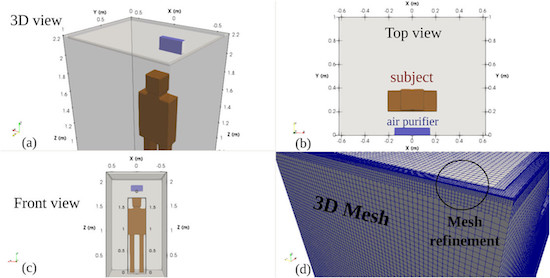
Computational domain of a subject inside an elevator’s cabin of a maximum capacity of five persons. The subject is considered as a simple hexahedral cell geometry because the focus is on the main flow circulation inside the cabin away from the subject’s boundary. (a) 3D view showing the 2.2 m height of the cabin and an air purifier installed at about 1.9 m above the cabin’s ground. (b) Top view illustrating the man’s position and the air purifier. (c) Front view. (d) Hexahedral 3D mesh cells with mesh refinement near the inlets/outlets and near the subject’s boundary.
Source: Research paper
“This is due to reduced flow mixing inside the elevator,” said another author Talib Dbouk. “Regulatory authorities should thus define the minimum ventilation required depending on the type of building.”
The study looked at the role of an air purifier, considering only the air intake and exhaust associated with the purifier, but not the mechanism inside the purifier that kills the virus. Even with an air purifier in place, airborne virus transmission is still significant.
“Our results show that installing an air purifier may increase the droplet spread,” Drikakis said. “The air intake integrated inside the purifier equipment induces flow circulation that can add to the transport of contaminated saliva droplets in the cabin.”
The observed effect increases with the number of infected persons in the elevator. Restricting the number of people allowed in an elevator would minimize the spread of the virus as would better design of air purifier and ventilation systems.