
To that end, the Cybersecurity and Infrastructure Security Agency (CISA) conducts Risk and Vulnerability Assessments (RVAs) for the federal civilian executive branch (FCEB), high priority private and public sector critical infrastructure (CI) operators, and select state, local, tribal, and territorial (SLTT) stakeholders. At the same time, the United States Coast Guard (USCG) conducts RVAs on maritime CI operated by SLTT and private-sector organizations.
The RVA assesses the entity’s network capabilities and network defenses against known threats. In Fiscal Year 2023 (FY23) ended September 2023, CISA and the USCG conducted a combined total of 143 RVAs across multiple CI sectors.
Effective Strategies
The goal of the RVA analysis is to develop effective strategies to improve the security of all stakeholders.

During each RVA, CISA and the USCG collect data through remote and onsite actions. Furthermore, this data ends up combined with national threat and vulnerability information to provide organizations with actionable remediation recommendations prioritized by risk of compromise.
Additionally, CISA designed RVAs to identify vulnerabilities threat actors could exploit to compromise network security controls. After completing an RVA, CISA and the USCG provide the assessed entity a final report that includes recommendations, specific findings, potential mitigations, and technical attack path details.
The FY23 reports provided these general observations:
- Assessors completed their most successful attacks via common methods, such as phishing, valid accounts, and default credentials
- Assessors used a variety of tools and techniques CISA has captured in previous RVA analyses to successfully conduct common attacks
- Organizations across varying CI sectors exhibited the same vulnerabilities
- CISA assessment personnel used common vulnerabilities facilitated by shortcomings in secure by design and default principles and other misconfigurations to compromise systems
To help organizations achieve greater cybersecurity understanding, CISA and the USCG developed the sample attack path based loosely on 11 of the MITRE ATT&CK framework’s 14 tactics.
Although the sample attack path does not encompass all the potential steps threat actors could use – and not all attack paths follow this model – a skilled threat actor could follow this path to successfully exploit a target.
Moreover, assessment teams attempt to find the easiest and most opportunistic means of accessing the target network without interfering with dependencies that would disrupt operations. The sample attack path highlights the more successful attack strategies used during RVAs, and the impacts these strategies have on target networks.
Attack Path
The attack path begins with a step required by many real-world attacks: Gaining Initial Access. Next, the attacker Executes code in the network to help establish a foothold and maintain Persistence on the network. Using the initial foothold on the network, the attacker uses Privilege Escalation to gain administrative rights. Using Defense Evasion to avoid detection, the attacker could attempt to steal credentials with Credential Access.
Once the attacker has credential access, they Discover the systems and networks. Moreover, by analyzing these systems and networks, the attacker gains an understanding of the infrastructure and identifies sensitive data that they deem worth compromising. The attacker then uses Lateral Movement throughout the network to access this sensitive data. Once entrenched in the network, the attacker switches their focus to Collection of the sensitive data. Attackers use Command and Control (C2) to keep communication channels open to support data Exfiltration and potential control after the attack.
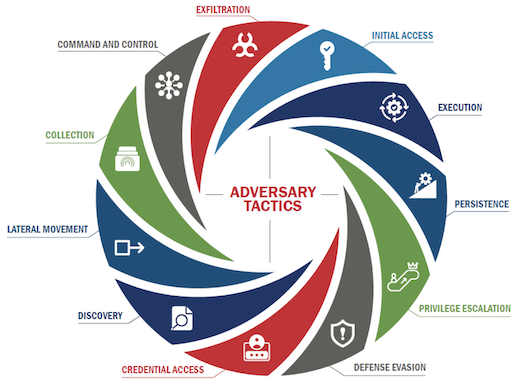
Cycle of tactics used by adversaries.
Source: CISA
After conducting trend analysis on the networks and network defenses of the entities in the 143 RVAs, CISA and the USCG made high-level observations that would improve the ability of CI organizations to secure and protect their networks.
Throughout the assessment lifecycle, valid accounts was the most prominent technique used across multiple tactics. Although CISA and the USCG teams do not directly emulate an adversary, they locate any conditions present in the environment, or use opportunistic techniques.
In previous years, assessors primarily used valid accounts to gain initial access into the network.
However, in FY23, they found opportunities to use valid accounts to move laterally through the network, evade defenses, and escalate privileges, although in many cases, the same accounts can end up used in several stages of the ATT&CK framework.
Therefore, a threat actor can do a lot with a small number of credentials accessed early on, especially when Microsoft Active Directory database is extracted using a domain account.
- To guard against the successful abuse of Valid Accounts, CI entities should:
- Implement strong password policies and phishing-resistant MFA.
- Implement Identity Access Management solution and granular access control to lock down privileged accounts, protect user credentials, and facilitate assigning users to groups with specific permissions.
- Monitor access logs and network communication logs to detect abnormal access.
- Swiftly identify and respond to detected abnormalities to reduce potential damage.
Mitigations
To deter a cyber threat actor’s ability to compromise systems or networks, CI entities should implement mitigations-centered intrusion prevention, such as:
- Deploying a centralized cyber threat intelligence platform to monitor and log critical data and using the platform to detect and remediate abnormal behavior in a timely manner.
- Implementing a secure network security architecture with multiple layers of protections—using next-generation firewalls, granular access controls, network segmentation, SIEM/SOAR, robust encryption, and secure communication.
- Implementing enhanced protection mechanisms alongside strong credential policies
Click here for more detail in the attack path scenario.