
Based on the materials reviewed, the claim goes beyond a routine leak post and suggests possible exposure of internal code repositories, access-related data, cloud and infrastructure references, and employee-linked records, according to a report with cybersecurity threat intelligence provider, SOCRadar.
A breach involving AstraZeneca ended up advertised on a Dark Web forum and also appeared on a data leak site associated with LAPSUS$. The listing claims the attackers obtained a large archive containing internal data, including source code, infrastructure-related material, and access-linked information.
The Dark Web post describes the victim as AstraZeneca and claims the exposed package includes source code in Java, Angular, and Python, as well as cloud infrastructure references tied to AWS, Azure, and Terraform, according to SOCRadar. It also claims the archive contains secrets and access material, including references to private keys and vault credentials, and lists the leaked package as a compressed archive totaling roughly 3 GB.
Essentially, the threat actors are advertising they have very sensitive enterprise data.

Part of the Attack
A file tree suggests the archive includes Java-based application code, including controllers, repositories, services, schedulers, configuration files, and Spring Boot resources. It also references internal project paths such as als-sc-portal-internal, database scripts, and environment-specific application files. That suggests the leak may include software development assets rather than only business documents, according to SOCRadar.
The Dark Web claim mentions AWS, Azure, and Terraform-related materials. Even when infrastructure files do not contain live secrets, they can still give attackers useful insight into architecture, naming conventions, deployment logic, and service dependencies.
Additionally, the breach may include GitHub Enterprise-related user information, access roles, account status fields, and identity-linked records. One of the samples appears to map internal identifiers to corporate email addresses, while a separate file structure suggests permission and wiki access workflows may also be a part of the breach, according to SOCRadar.
The file tree also points to large numbers of SQL scripts, table definitions, views, sequence files, batch processes, and inventory or order-management components, according to SOCRadar. In practical terms, that suggests the breach could touch internal business operations, supply chain workflows, and system administration data, not just developer artifacts.
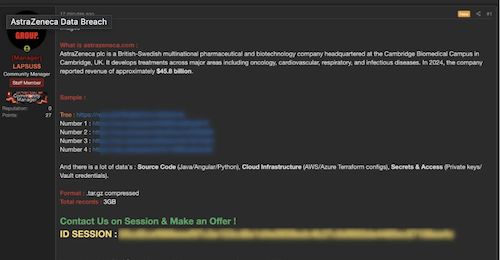
Dark Web post advertising AstraZeneca breach.
Source: SOCRadar
At this point, the SOCRadar researchers said LAPSUS$ claimed the breach through Dark Web-related channels and a breach listing attributed to the group. The listing on the threat actors’ data leak site appears to advertise AstraZeneca data for sale.
Moving Beyond Traditional Attacks
“This incident reflects how financially motivated threat groups are evolving their playbooks, moving beyond traditional leak-and-extort tactics toward more controlled, buyer-driven monetization models,” said Gunter Ollmann, chief technology officer at Cobalt. “By selectively releasing proof and holding back full datasets, attackers are effectively turning breaches into commodities, which increases both their leverage and the longevity of the threat.
“The concerning element here is the apparent exposure of source code, infrastructure-as-code, and secrets, which together create a blueprint for follow-on attacks across the software supply chain,” Ollmann said. “Even if the initial breach scope ends up contained, the downstream risk expands rapidly when attackers gain insight into how systems end up built and operated. Organizations need to treat these types of exposures as systemic risk events and prioritize continuous testing and validation of both their codebases and cloud configurations to limit cascading impact.”
Click here for more on the SOCRadar report.