
That, however, couldn’t be further from the truth as 92 percent of breached organizations were small to medium businesses with fewer than 1,000 employees, according to Verizon’s 2025 Data Breach Investigations Report (DBIR).
“This really illustrates that there is no such thing as a business so small it can fly under the radar of the threat actors. They are the great equalizers when it comes to causing breaches,” said the researchers in the report.
There is no real answer to why state-sponsored actors are clamoring to steal technologies used to manufacture components in these volatile times, it could be, as the researchers said, changes in contributors’ datasets.

When it comes to breaches, manufacturing suffered a rise with 1,607 confirmed data breaches as opposed to only 849 last year. A majority of threat actors appear to target manufacturing for financially motivations (87 percent).
System Intrusion
The top three patterns in manufacturing have not changed over the last year. At 60 percent of breaches, system intrusion is still firmly on top and appears more than twice as often as social engineering, which holds the number two position at 22 percent. Basic web application attacks is at number three at 9 percent, according to the report.
What does this mean for members of this sector? They are likely increasingly becoming a target by more sophisticated threat actors who are willing to go the extra mile to gain access to their victims’ environments.
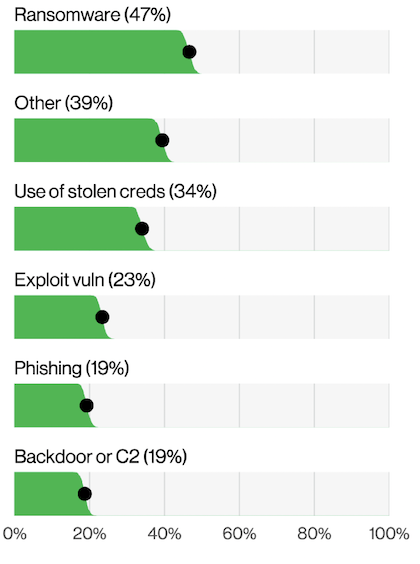
Once again, ransomware tops the list of types of attacks manufacturers suffer.
Source Verizon DBIR
One notable change, however, is that the presence of malware in manufacturing. This is where breaches rose to 66 percent this year.
For the last five years, malware breach levels remained relatively steady at between 40 percent and 50 percent. With that in mind, ransomware (47 percent) still looms large, as it does in most every other industry.
Hacking via the use of stolen credentials shows up in more than one-third (34 percent) of manufacturing breaches, while exploit vulnerabilities (23 percent) and phishing (19 percent) appear in approximately one- quarter and one-fifth, respectively, of all breaches.
Additionally, attackers look to steal internal data like sensitive plans, reports, and email, followed by personal data. Credentials at 25 percent and secrets at 17 percent round out the types of stolen data.
Click here to register to download the Verizon DBIR report.