
That knowledge could make drones safer and more stable in turbulent conditions, or in cities where wind gusts from tall buildings make flying more difficult. It could make applications like parcel delivery, food delivery, environmental monitoring and physical security missions more feasible and reliable.
A study conducted by RMIT and the University of Bristol in RMIT’s Industrial Wind Tunnel facility – one of the largest of its kind in Australia – is the first to precisely measure the stability of a Nankeen Kestrel’s head during hovering flight, finding movement of less than 5mm during hunting behavior.
Surface Area Changes
“Our results acquired over several years, show birds of prey rely more on changes in surface area, which is crucial as it may be a more efficient way of achieving stable flight in fixed wing aircraft, too.”

Kestrels and other birds of prey are capable of keeping their heads and bodies extremely still during hunting. Additionally, this specialized flight behavior, called wind hovering, allows the birds to “hang” in place under the right wind conditions without flapping. By making small adjustments to the shape of their wings and tail, they can achieve incredible steadiness.
Thanks to advancements in camera and motion capture technology, the research team observed two Nankeen Kestrels, trained by Leigh Valley Hawk and Owl Sanctuary, at high resolution.
Fitted with reflective markers, researchers were able to track the birds’ precise movements and flight control techniques during non-flapping flight.
“Previous studies involved birds casually flying through turbulence and gusts within wind tunnels; in our study we tracked a unique wind hovering flight behavior whereby the birds are actively maintaining extreme steadiness, enabling us to study the pure control response without flapping,” Mohamed said.
By mapping these movements, the researchers gained insights that could end up utilized to achieve steadier flight for fixed wing aircrafts.
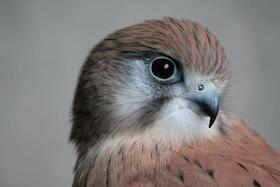
Studying the Nankeen Kestrel’s flight may make for smoother ride for future drones.
Source: RMIT
Similar Behaviors
“The wind hovering behavior we observed in kestrels is the closest representation in the avian world to fixed wing aircraft,” said Mohamed.
“Our findings surrounding the changes in wing surface area could apply to the design of morphing wings in drones, enhancing their stability and making them safer in adverse weather.”
Moreover, the usefulness of current fixed wing unmanned aerial vehicles (UAV’s) significantly decreased by their inability to operate in gusty wind conditions, said Associate Professor of Bio-Inspired Aerodynamics at Bristol University and joint last author, Dr. Shane Windsor.
“UAV’s are being used in the UK to deliver post to remote islands, but their operation time is limited because of regular gusty conditions,” Windsor said. “Current commercial fixed wing aircraft have to be designed with one fixed geometry and optimized to operate at one flight condition.
“The advantage of morphing wings is that they could be continually optimized throughout a flight for a variety of conditions, making the aircraft much more maneuverable and efficient,” he said.
Gusty Conditions
The team now aims to further their research by examining the birds under gusty and turbulent conditions, which would see further learnings in stable flight with the goal of allowing UAVs to operate more safely and more often.
Furthermore, while initially focused on smaller aerial vehicles, the team hopes to simplify the data collected so they can adapt it for larger scale aircraft.