
“For a dust hazard to be properly reduced and/or controlled, it must be presented as its own distinct hazard issue, not as an issue of tidying up the place,” said one respondent in a “Call to Action” report by the Chemical Safety Board (CSB).
While other hazards are more clearly defined and regulated, such as fall arrest gear and personal protective equipment, it is clear there is a network of assumptions on combustible dust and how it differs from traditional or common safety protections, according to the CSB report, entitled, “Dust Hazard Learning Review,” produced by Dynamic Inquiry LLC. The report gathered feedback from industries that handle combustible dust to identify the key barriers to improvement in the control and mitigation of combustible dust hazards.
Corn Dust in Air
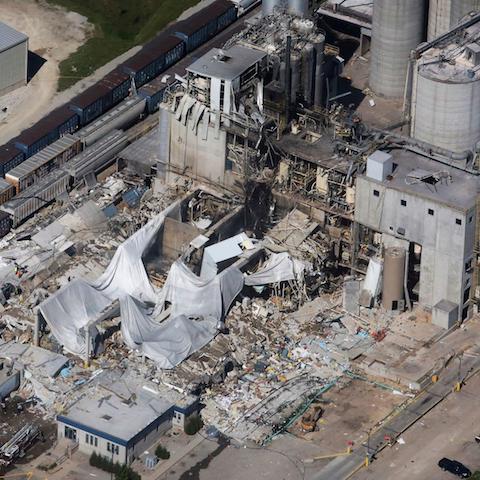
Shortly before the 11 p.m. blasts, workers saw or smelled smoke on the first floor of one of the mill buildings. In trying to find its source, workers focused on a piece of equipment called a gap mill. While inspecting the equipment, workers witnessed a filter connected to an air intake line for the mill blow off, resulting in corn dust filling the air, and flames shooting from the air intake line, followed by one or more explosions.

The incident pointed out the potentially lethal situation combustible dust represents – and how little companies regard the risk.
“This learning review represents a new method for the CSB to examine an incident,” said CSB Chairman Katherine Lemos. “The outcome of this specific review provides an opportunity for dust hazards to be examined from multiple perspectives, which may allow for a greater understanding of pre-existing assumptions and scenarios.”
Some of the comments from respondents, which remained anonymous, pointed to real problems on how to combat combustible dust.
‘Spending Money on Garbage’
“Dust is looked at like spending money on garbage,” said one respondent in the study. “Combustible dust should be a widely recognized hazard, just like any other workplace hazard,” said another.
Other quotes acknowledge the conflicts that frequently exist between safety and production.
“The next largest challenge is convincing unknowledgeable executive decision makers why the cost [of dust control] is a necessary part of the business model for the operation of combustible dust processes,” one respondent said.
Respondents said dust seemed to have a lower priority than other safety issues. So, why is that? One reason is dust does not command the level of respect common to most other hazards. “Most companies visited don’t understand the volatility of their dust problem,” one respondent said. “Most of our customers are not aware of their combustible dust and the required protections,” another said.
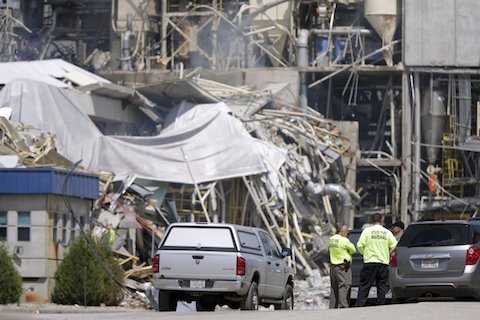
Aftermath of the Didion Milling facility explosions in Cambria, Wisconsin where 5 workers died and 14 suffered injuries. Combustible dust must be “presented as its own distinct hazard issue,” said one respondent in a CSB report.
The October 24, 2018, “Call to Action” gathered comments on the management, control and understanding of combustible dust from companies, regulators, inspectors, safety training providers, researchers, unions and the workers affected by dust related hazards.
Ongoing Challenges
The aim of the CSB report was to achieve a better understanding of the varied challenges faced by each stakeholder group and potentially unearth yet-to-be-explored pathways of learning on combustible dust. In all, the CSB received 57 responses which end up utilized throughout the safety review.
It became clear the Didion Mill explosion was not an anomaly, rather it was an example of how the myriad of issues could combine in an adverse outcome event.
While dust is not something workers face on a daily basis, it can lull personnel to sleep to the danger.
“Many plants are still in the complacent mindset, where they have never experienced a major event and hence feel their risk is not high enough to worry about,” one respondent said.
“Complacent mindset of being low risk purely based on no significant event history,” said another.
“The common thinking is, ‘It never happened before, that costs too much money, we don’t have a problem, etc,’ are often the challenges in a growing climate of risk acceptance,” said another respondent.
Key Issues
In the report, the CSB identified the following key issues:
- Sharing Information: The sharing of information between companies, industries, and regulators was the most desired goal requested from the respondents. Respondents felt having a platform to share information and experiences openly, without fear of reprisal or punishment, would offer the best path forward to learn from others regarding dust hazard mitigations and best practices.
- Barriers to Improvement: Respondents identified the inability to achieve a dust-free environment. Review of the comments found this may have been due to a normalization of risk.
- Controls: The Call to Action revealed important challenges with the language used to describe combustible dust and its mitigation, suggesting it be presented as a distinct hazard, not simply as an “issue of tidying up the place.” It was also clear all levels of communication need to improve within facilities that have combustible dust.
“Our goal is to continue to examine incidents from multiple perspectives to better enhance prevention and continually drive chemical safety,” Lemos said.
Click here for the full CSB “Call to Action” report.