
Think about it, hijacked networks, cryptocurrency heists, and corporate espionage are a few examples of the spiraling cyber threat. Every year, threat actors become savvier and increasingly callous – attacking power grids, shutting down hospitals, and stoking geopolitical tensions.
To that end, state-sponsored attackers wield every element of their national power to target the United States and its critical infrastructure, according to the Federal Bureau of Investigation (FBI) Internet Crime Report 2025. Skilled cybercriminals exploit new and longstanding vulnerabilities to steal money and hold data for ransom.
One example was Operation Level Up, which countered crypto investment scams. This FBI-led initiative reduced potential losses by more than $500 million since 2024.

Vigilence
That is all to say, it has never been more important to be diligent with your cybersecurity, social media footprint, and electronic interactions. Cyber threats and cyber-enabled crime will continue to evolve as the world embraces emerging technologies such as artificial intelligence.
At the time of the report’s publication, the FBI was taking part in Operation Winter Shield, which highlights concrete steps for organizations to bolster their digital security. The FBI remains fully committed to ensuring Americans’ safety online and reinforcing the recent Executive Order targeting cybercrime, fraud, and foreign scam centers, to hold those accountable who exploit the internet for nefarious purposes.
In terms of attacks, ransomware is among the highest reported cyber threats targeting critical infrastructure organizations.
Ransomware is a type of malicious software designed to block access to a computer system until money is paid. In 2025, the IC3 received more than 3,600 complaints reporting ransomware, with losses exceeding $32 million.
In 2025, the following ransomware variants were among those most frequently reported variants to the FBI via IC3, accounting for 56.8 percent of the total of ransomware incidents reported.
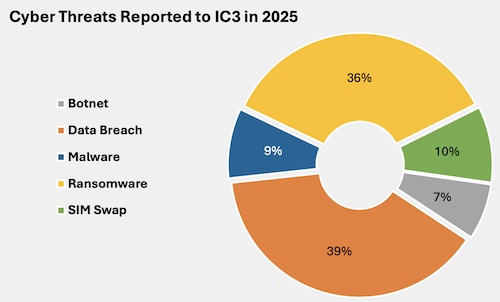
These are the types of attacks and threats reported to the FBI last year.
Source: FBI
The 2025 loss amount reported to IC3 attributed to these variants is over $16 million, almost half (49.8 percent) of the total losses reported. Regarding ransomware adjusted losses, this number does not normally include estimates of lost business, time, wages, files, or equipment, or any third-party remediation services acquired by an entity.
In some cases, entities do not report any loss amount to the FBI, thereby creating an artificially low overall ransomware loss rate. Lastly, the number only represents what entities report to the FBI via IC3 and does not account for the entity directly reporting to FBI field offices.
Best Practices
A key step to limit damage and lower risk of a ransomware attack is to establish and maintain a solid foundation of industry best practices, which can help mitigate the threat and reduce your organization’s attack surface. The FBI recommends the following mitigating practices for companies:
- Create off-site or offline backups and regularly maintain backup and restoration. Additionally, ensure all backup data ends up encrypted, immutable (i.e., cannot be altered or deleted), and covers the entire organization’s data infrastructure.
- Eliminate default passwords and credentials when installing software and require all accounts with password logins (e.g., service accounts, admin accounts, and domain admin accounts) to comply with NIST’s standards.
- Disable and remove unnecessary protocols by default. Audit user accounts with administrative privileges and configure access controls according to the principle of least privilege.
- Enable multi-factor authentication (MFA) for all services to the extent possible, particularly for webmail, virtual private networks, and accounts that access critical systems.
- Secure initial access points – to help in detecting the ransomware, implement a tool that logs and reports all network traffic, including lateral movement activity on a network. Endpoint detection and response (EDR) tools are particularly useful for detecting lateral connections as they have insight into common and uncommon network connections for each host.
- Segment networks to prevent the spread of ransomware. Network segmentation can help prevent the spread of ransomware by controlling traffic flows between – and access to – various subnetworks and by restricting adversary lateral movement.
- Keep all operating systems, software, and firmware up to date. Timely patching is one of the most efficient and cost-effective steps an organization can take to minimize its exposure to cybersecurity threats. Prioritize patching known exploited vulnerabilities in Internet-facing systems.
Click here for more on the FBI’s Internet Crime Report 2025.