
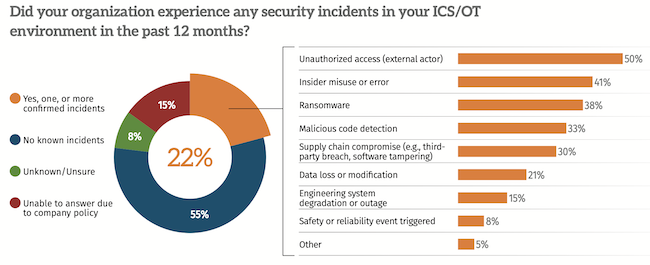
To that end, in the past year, 22 percent of respondents suffered a cybersecurity incident and of those a majority (50 percent) came from unauthorized external access and/or ransomware (38 percent), according to SANS Institute’s The State of ICS/OT Cybersecurity 2025 report sponsored by cybersecurity provider, OPSWAT.
These incidents have real-world impacts, with 40 percent of incidents causing a disruption in ICS/OT operations, 13 percent resulting in financial losses or data compromise, 8 percent posing a risk to physical safety or reliability, and 6 percent involving the theft of intellectual property.
The report, based on responses from more than 330 professionals across critical sectors, highlights progress and persistent blind spots in areas such as asset visibility, secure remote access, and incident response readiness.

Where Attacks Begin
In the report, it shows half of ICS/OT incidents began with unauthorized external access, often through third-party remote maintenance.
Along those lines, fewer than 15 percent of organizations have advanced remote access controls.
Additionally, 12.6 percent of respondents report full ICS Kill Chain visibility, leaving critical detection gaps at Purdue Levels 2–3.
And this kicker is, in this day and age of cybersecurity awareness, 14 percent of respondents felt fully prepared for emerging threats.
“This year’s findings show that while progress is being made, the industry still faces significant challenges in securing converged environments,” said Jason Christopher, SANS Institute author of the report. “Organizations must prioritize visibility and segmentation to mitigate these risks effectively.”
“Our earlier research with the SANS Institute showed that most organizations dedicate less than 25 percent of their security budgets to OT,” said Matt Wiseman, director of product marketing at OPSWAT. “The new findings make it clear that increased spending alone is not enough. The priority now is smarter investment in the controls that matter most for safety and uptime: Segmentation, secure remote access, and scanning inbound files and devices before they reach the operational environment. OT security requires an integrated approach that closes the gaps attackers continue to exploit.”
Two trends continued from previous reports.
First, industry continues to improve in detection times for ICS/OT incidents, with nearly 50 percent of incidents detected within the first 24 hours.
Source: SANS
Second, manufacturers are improving on containment, with over 65 percent of detection-to-containment gaps addressed in the proceeding 24 hours. That means, on average, ICS/OT incidents end up detected and contained within 48 hours.
Remediation Takes Time
On the other end, remediation, which includes the act of eradicating the threat and recovering operational integrity, still takes days to achieve, on average, with 22 percent taking two to seven days to recover.
With that in mind, the risks here are real, with 19 percent of incidents in 2025 taking over a month to remediate (and 3 percent taking over a year).
As it is with most cybersecurity issues, preparation is still key to responding and recovering quickly during an i incident. The report showed 57 percent of respondents have a dedicated ICS/OT incident response plan, a slight increase from previous years that represents further maturity across the industry.
Moreover, if an organization has threat intelligence capabilities and works in a regulated environment, the coverage for ICS/OT-specific incident response plans jumps to 70 percent.
Click here to download the report.