
To that end, companies operating in industrial sectors worldwide are designing and deploying their operational technology (OT) environment to improve security, increase efficiency and provide a platform for innovation, according to the Cisco inaugural 2024 State of Industrial Networking Report.
Cisco, in association with Sapio Research, commissioned the double-blind study to establish the highest business and technical priorities for industrial networks today. The goal was to understand how global organizations are overcoming challenges, where the opportunities lie, and how to align resources for success. The study ended up conducted at companies in 17 countries, operating in more than 20 sectors including manufacturing, utilities, energy, and transportation.
The report found cybersecurity risks are the number one internal barrier to growth. Also, 89 percent of respondents said cybersecurity compliance is very important in their operational network. Also, the number one challenge when running industrial infrastructure is mitigating against cyber threats.

The report also found IT and OT teams need to become more collaborative.
Management of organizations’ enterprise and industrial networks is increasingly overlapping, the report said. Executive leadership can see the benefits of a unified approach, but currently the two functions remain siloed; impacting efficiency and threatening the overall security posture.
Along those lines, 41 percent of firms’ IT and OT teams are working independently on cybersecurity. However, organizations believe the top outcome of better collaboration would be improved cybersecurity. Additionally, 92 percent of executive leaders and C-suite believe there is significant value in having a unified cybersecurity solution.
On another technology front, there is a clear sense artificial intelligence (AI) will boost business growth for those who can successfully use it to run better industrial networks. That is why 48 percent of respondents believe AI is the emerging technology likely to have the biggest impact within the next five years. With that in mind, after cybersecurity, AI is the number two spending priority in the next two years.
There are other issues facing organizations when it comes to cybersecurity including the skills shortage, inflation and increased levels of risk.
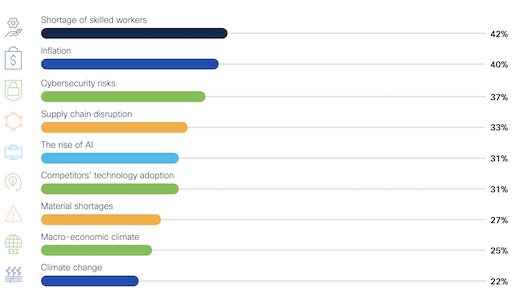
Respondents listed their biggest external obstacles to their organization’s growth.
Source: Cisco
Over the past few years, businesses worldwide have faced macro-level challenges ranging from supply chain issues to a global pandemic. But there are other issues hitting companies right in the face.
The number one concern cited by 42 percent of respondents is a shortage of skilled workers, closely followed at 40 percent by inflation, and cybersecurity risks at 37 percent.
While there are those that fear new technologies will replace workers, survey respondents feel technology is an enabler in the industrial sector.
The top way these organizations are mitigating against the internal obstacles they face is through upskilling or reskilling their employees; followed by adopting AI, which can reduce manual tasks and speed up processes.
While the IT environment sees a daily barrage of attack attempts, organizations on a global basis recognize the need to invest more in OT technology to take advantage of Industry 4.0.
To that end, 63 percent of respondents ramped up spend on industrial infrastructure over the past year.
Click here to download the report.