
Detection probability can end up reduced by 16 percent for methane gas leaks from main pipelines and by as much as 38 percent points for service line leaks in urban areas, compared to rural settings, said researchers at SMU.
Main lines are the larger, high-pressure pipelines under streets that carry gas to neighborhoods, acting like a main artery, while service lines are smaller ones connecting the main line to an individual customer’s meter, delivering lower-pressure gas directly to a home or business.
“This matters because methane is both a safety risk and a potent greenhouse gas, and these detection challenges mean leaks can go unnoticed and unaddressed longer than we’ve assumed,” said Kathleen Smits, one of the co-authors of the study and the Solomon Professor for Global Development at SMU’s Lyle School of Engineering and a Fellow of the Maguire Energy Institute at SMU’s Cox School of Business.

Methane gas from pipeline leaks can potentially cause dangerous explosions. It is also the second-largest contributor to global warming after carbon dioxide. Detecting and repairing these leaks could meaningfully reduce climate impacts.
The SMU study is one of the first to systematically compare the effectiveness of walking, driving and simulated unmanned aerial vehicle (UAV) surveys for detecting methane leaks in realistic urban settings, Smits said.
Led by SMU postdoctoral researcher Venkata Rao Gundapuneni, the research team conducted controlled natural gas pipeline leak experiments in Colorado, examining how factors such as leak rate, wind conditions and survey height influenced the probability of detection.
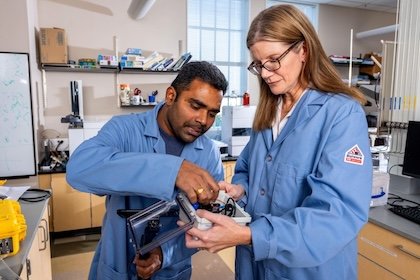
SMU’s Venkata Rao Gundapuneni, left, and Kathleen Smits, right, calibrate a methane gas sensor to minimize errors and improve accuracy. They were part of a research team that found the complexities of urban environments significantly impair the ability to detect natural gas leaks from underground pipelines.
Source: Southern Methodist University
Key findings from the study include:
Leak rate matters significantly:
The probability of detection improved dramatically with increased leak rates – by 15 to 37 percent for main lines and 24 to 35 percent for service lines when comparing low-rate leaks (1 standard cubic foot for hour) to high-rate leaks (21 standard cubic foot for hour). This means smaller, slower leaks are far more likely to go undetected in urban settings.
Distance from pipeline reduces detection:
Surprisingly, even a small shift – 15 meters downwind from the pipeline – dropped the detection probability by 65 percent for walking surveys, 49 percent for UAV surveys, and 10 percent for driving surveys, compared to surveys conducted directly over the pipeline.
Detection threshold sensitivity:
The study found detection threshold settings severely impact success rates, particularly for low leak rates and service lines. A mere 0.05 parts per million increase in detection threshold could reduce detection probability by 30 to 40 percent for main lines at low leak rates and for service lines across all tested leak rates.
“The important takeaway from our results is that no single method works in every condition,” Smits said. “The key is to know the conditions and know how the method performs in those conditions.”
Click here to view the study.