
With hydrogen already making progress as a major player in the energy industry, in order for hydrogen to move forward it is essential to ensure the safety issues via ultra-sensitive gas detection technology over the entire gas-dealing processes such as gas production, storage, and transportation.
One catch is, though, conventional gas-leakage sensors using electric signals are prone to yield electrical sparks, which can cause an explosion of leaked hydrogen gas.
Developing Hydrogen Leak Sensor
That is where the Korea Institute of Science and Technology (KIST) comes in. They created a team led by Dr. Minah Seo of the Sensor Systems Research Center & KU-KIST Graduate School and Prof. Yong-Sang Ryu of School of Biomedical Engineering, College of Health Sciences, Korea University. They are developing a non-contact terahertz light sensor that can detect hydrogen gas leaks as small as 0.25 percent in real-world environments at room temperature and pressure.

Spectroscopy is the non-contact observation method measuring changes in the value of optical constants of an analytic sample.
In this method, it is possible to observe changes in the reacting substance non-invasively, by measuring variations in the optical properties when the reacting substance encounters hydrogen gas.
Terahertz electromagnetic waves have a very wide frequency band, which makes them sensitive to the natural vibrations of gas molecules, which can end up utilized in spectroscopy to resolve minute unique information and differences in molecules such as various gases, DNA, and amino acids. However, due to the low probability of interaction with trace amounts of hydrogen gas and the lack of technology to amplify the signal of terahertz waves, it has been difficult to utilize in practice.
To that end, the research team focused on the property of hydrogen permeating into palladium metal, and devised a research strategy to address this through the interaction of light and matter.
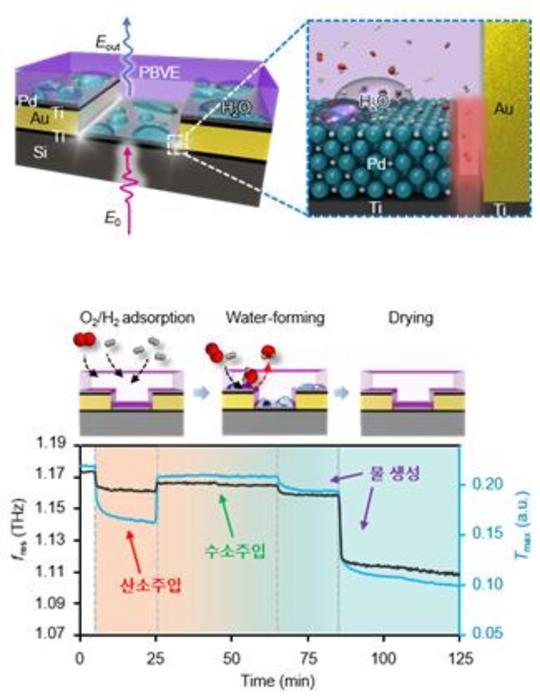
Graphic shows the metastructure and optical constants of the palladium-catalyzed reaction as a function of the concentration ratio of hydrogen and oxygen, the thickness of the resulting water layer, and the resulting terahertz signal changes.
Source: Korea Institute of Science and Technology (KIST)
Researchers developed a gas-detection sensing platform that can sensitively measure changes in terahertz optical signals caused by trace amounts of gas using metamaterials that have the ability to amplify signals in specific bands of electromagnetic waves.
Amplify Signals
The team first developed a terahertz metamaterial that can amplify signals in the gas-sensitive terahertz band, and then uniformly applied palladium to the metamaterial to create an extremely narrow 14 nm space to maximize the sensitivity of the terahertz signal.
The palladium plays bifunctional roles in not only the catalytic reaction of adsorbed hydrogen and oxygen to produce water molecules on the surface, but also in the hydrogen storage.
For mimicry of real-world environments (80 percent of nitrogen, 20 percent of oxygen), hydrogen and oxygen gases ended up injected into the developed sensing chamber and exposed to the terahertz sensing platform. The results showed great responsibility with respect to exposed hydrogen gas via significant optical signal variation, and reserchers analyzed these in a real-time.
Using ultra-thin palladium together with ultra-sensitive optical band width (the terahertz) provided synergetic performance enabling to detect under 1 percent of hydrogen gas leakage to the real-time detection level.
In addition to the quality detection performance, the reusability of the detection platforms was also a consideration during the platform designing process.
In general, metal hydrides such as palladium are difficult to reuse because they are irreversible, meaning they cannot return to their original state after a phase change. However, the KIST-Korea University research team secured the reusability of the sample through special processing technology. They also succeeded in developing a technology to contactlessly track the mechanism of hydrogen desorption at the nanometer scale in real time through optical signals.
‘Promising Technology’
“Existing light sensors have very limited reliability in normal temperature, pressure, and humidity environments, but this is a promising technology that can detect and screen not only gases but also various biochemical substances in extremely small amounts by dramatically increasing sensitivity,” said Dr. Minah Seo, lead author of the study. “(We can) develop a system that can immediately respond to various harmful factors, gases, and diseases through mobile, on-site, and real-time inspections.”
“In addition to the terahertz measurement technology, it has opened up the possibility of visually checking various gas adsorption and desorption processes and molecular-level chemical reaction mechanisms occurring on metal surfaces,” said Professor Ryu Yong-sang of Korea University, lead author of the study.