
A cultural divide, no clear understanding of technical barriers, and a lack of clear ownership between IT and OT blocks of organizations from having a unified cybersecurity strategy.
With those issues are very important, they all fall under the umbrella of a clear lack of communication skills within departments – and the entire enterprise. That leads to organizations needing to work toward establishing a unified IT and OT approach to address threats and close gaps in security that leave organizations vulnerable, according to a Ponemon Institute survey entitled “The 2021 State of Industrial Cybersecurity: The Risks Created by the Cultural Divide Between the IT & OT Teams” sponsored by OT security provider, Dragos.
Overall Lack of Communication
The report showed there are clear misunderstandings between groups. This lack of communication not only between IT and OT, but also with business leadership and other key departments, can end up being a huge issue.
“It is not IT people not speaking OT language, it is also any security person being able to speak business language,” Applegate said. “Boards want to know, what are our risks? What are you doing about that risk? So, they can say ‘I am able to check it off, so everything turns green. Now I can say we handled the risk in that area.’”

Half of respondents in the survey said cultural differences between engineers, security professionals, and IT staff are the main challenge. In addition, 44 percent said there are problematic technical differences between traditional IT-specific best practices and what is possible in OT environments, such as patch management and unique requirements of industrial automation equipment vendors.
On top of that, 43 percent of respondents said there is a lack of clear “ownership” on industrial cyber risk and uncertainty around who leads the initiative, implements the controls and supports the program.
Those differences increase the level of risk for an organization – and again, point to the need for greater communication.
Reactionary Mode
Along the lines of communications, manufacturers still remain stuck in a reactionary mode. However, by increasing the level of communication between departments, security can become stronger.
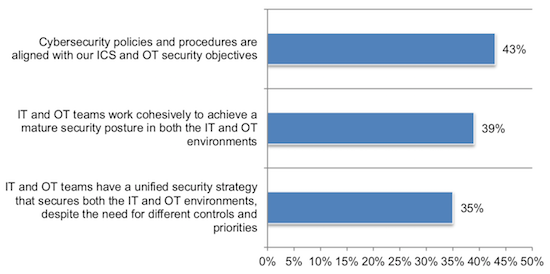
Perceptions about IT and OT alignment with strongly agree and agree responses combined.
Source: Ponemon Institute
“You have got to have a cross-functional team where everyone has the same goal to keep the equipment reliable, and that eliminates the communication barriers,” Applegate said.
However, Applegate did say one aspect of the study worried him a bit where 21 percent of respondents said they reached full security maturity, “which is a shock, because I never think we will ever be mature. My worry is a lack of understanding may lead them to a false sense of security.”
Not only did 21 percent of respondents say their ICS/OT program activities have achieved full maturity, half of organizations said are in the early and middle stages, while the remaining 29 percent are late-middle stage.
On top of that, 35 percent of respondents said someone responsible for ICS and OT cybersecurity reports IT and cybersecurity initiatives to the board of directors. Of these respondents, 41 percent said such reporting takes place only when a security incident occurs. That compares to a more mature environment where there is a regular dialog with the board.
That follows along with senior managers lacking awareness of the risks and threats to the OT and ICS environments. Forty-eight percent of respondents said their organizations understand the unique cyber risks and have specific security processes and policies for OT and ICS environments. However, 43 percent of respondents said senior management understands the cyber risks and provides enough resources to defend OT and ICS environments.
Back to Basics
To achieve a secure environment, Applegate said it is not magic. It is all about getting back to the fundamentals and keep building to make them stronger.
“It is all about going back to the basics, making sure communication is right, build a solution that is tailored for OT, and don’t shoehorn in a bunch of IT stuff that doesn’t protect you,” he said. “You have to start with smart building blocks. If you try to employ a silver bullet to solve your problem, and you haven’t been maintaining the basics where you don’t know what is on your network and you haven’t built a resilience program, there is no silver bullet. There is hard work involved to put the basics in place that keeps your inventory updated all the time and you know a vulnerability is coming. So, when you do have a vulnerability you have a playbook ready, you can say we need to put a patch on, or we need to mitigate it this way. It is all about the basics and maintaining them perfectly.”
Click here to register for the report.