
Unmanned aerial vehicles (UAVs), or drones, are a huge asset for intelligence, surveillance and reconnaissance (ISR) operations. The Australian Army has drones ranging from the tiny Black Hornet – which is about the size of a whiteboard marker – to larger models with wide ranging surveillance capabilities.
Despite their ubiquity and utility, however, all military UAVs end up hindered by the same simple problem – the sky changes color, but they don’t.
In a collaboration with the Department of Defense, FII researchers, led by Dr Kamil Zuber, developed a range of lightweight polymer panels that can change color on demand.

The polymers are electrochromic materials, meaning they change color in response to an electric field, and the exact colors can end up tuned to specific voltages.
“Similar technology has been used in luxury cars, for diming mirrors, and on the windows of the Boeing 787 Dreamliner,” Zuber said. “But those applications are slow, require high power consumption to switch, and the electric flow must be maintained to sustain the change state. Our panels, on the other hand, have switching speeds in the range of seconds and offer color memory, which means they retain their switched color without a continuously applied voltage. They also operate in the range from -1.5 to +1.5 volts, which means you only need to use an AA battery to activate the change.”
In addition to their chameleon-like characteristics, the panels are inexpensive, lightweight and durable, and can be either rigid or flexible, making them ideal for use on drones of all sizes and specifications.
“We have built a small-scale frame of a UAV and put our panels on it. We have demonstrated it against all sorts of different sky states and completed a range of validation testing showing how these materials can respond in actual use,” Zuber said. “We have five or six different materials, and each of the materials can produce two to three distinct different colors.”
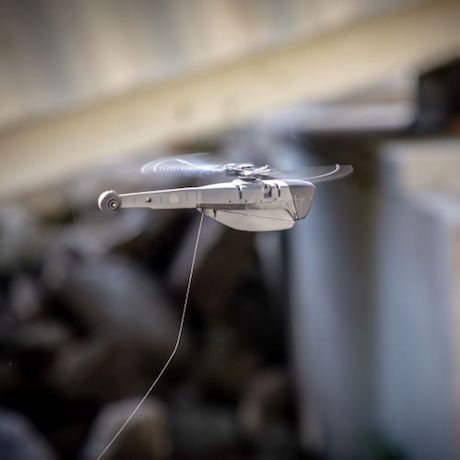
Drones are currently hindered by the same simple problem: The sky changes color, but they don’t. New technology may soon change that.
Source: University of South Australia
“At this stage, we’ve been working mainly on the panels and the hardware, but during the latest stage of the project we’ve developed prototype electronics for the controller, which is something that could test the state of the sky and then automatically adjust the voltage to the panel to tune it to the right color,” Zubar said. “So, if the UAV passed in front of a cloud, it would turn pale, then when it moved back into blue sky, it would turn back to blue.”