
The Chemical Safety Board (CSB) released its final report on the September 21, 2020 fire during hot work at the paper mill. The fire started when a heat gun ignited flammable materials during maintenance work inside a tower. The fire spread to a connected tower, fatally injuring two workers.
On September 21, 2020, the paper mill was undergoing a planned shutdown, and associated maintenance and capital project work was ongoing throughout the facility.
The pulp bleaching process is corrosive by design, and the upflow and downflow towers were constructed of corrosion-resistant materials. Due to the corrosive nature of the process, the upflow and downflow towers required periodic maintenance to their inside surfaces.

The upflow tower was constructed of fiber-reinforced plastic (FRP), and Blastco’s repair work in the upflow tower required the application of flammable epoxy vinyl ester resin and sheets of fiberglass to the inside walls of the vessel. Cool ambient temperatures in the area on the night of the incident caused the resin to harden slower than the Blastco workers anticipated, resulting in the newly applied resin and fiberglass sliding down the walls of the vessel.
Blastco workers attempted several means of addressing the issue but were ultimately unsuccessful. Two Blastco workers resorted to using a portable, electric heat gun to warm the resin, enabling it to harden faster. The Blastco crew did not warn or communicate to Evergreen or Rimcor its use of the heat gun, which was an ignition source in the presence of the flammable resin.
Timeline
Between 7 p.m. and 8 p.m. on Sunday, September 20, 2020, the night shift crews for Blastco and Rimcor arrived and began preparing for their shift in the D2 upflow and downflow towers, respectively. Evergreen issued a Safe Work Permit and a confined space entry permit separately to Blastco and Rimcor for their work in the towers. By about 8:20 p.m., Blastco had completed permitting and setup and entered the upflow tower.
To prepare the FRP resin for use inside the upflow tower, Blastco workers first opened a 55-gallon drum of raw resin outside of the vessel. Workers “activated” the resin by mixing a cobalt “promoter,” or catalyst, and DMA into the drum. Next, workers filled five-gallon buckets with “promoted” resin from the drum. Inside the vessel, workers then performed the second activation step, which involved mixing MEKP and DMA into the buckets.
After the promoted resin was initiated, it was ready for use. Blastco workers dipped paint rollers into the buckets and rolled the resin on the wall, subsequently alternating layers of resin and fiberglass matting until the specified thickness was reached.
Throughout the night shift, Blastco experienced problems with the resin application. Blastco workers told the CSB the cold temperatures were interfering with their work and their progress was slower than expected. Colder temperatures result in longer gel times, which ultimately resulted in Blastco’s lamination patterns sliding down the walls of the vessel before the resin hardened.
Addressing Resin Issue
Blastco workers attempted several means of addressing the resin gel time. First, after the workers added MEKP into the five-gallon buckets, they added additional DMA. Adding the additional DMA decreased the gel time.

Electric heat gun found after the fire.Source: CSB
Second, the workers changed the method they were using to apply the resin and mat onto the wall. Instead of stacking the layers to the full thickness (five or more layers) in one spot before moving onto the next spot, the workers stacked two layers of mat on one side of the vessel and then moved to the opposite side to add two more layers. They rotated and added two more layers next to the first two. With this method, there was less weight on the wall of the tower, which resulted in less movement of the new material. While these strategies helped somewhat, neither of these methods sufficiently addressed the overly long gel time, and the workers continued to struggle.
Sometime after 2 a.m. on September 21, 2020, one of the workers went to locate drum warming bands. The worker could not locate the warming bands in their usual location on Blastco’s job trailer. Instead, one of the Blastco workers obtained a heat gun from the Blastco trailer, brought it into the tower, and began using it to warm the resin for easier application. They warmed the resin by turning on the heat gun and pointing it into the bucket of resin, stirring while they added heat.
At 5:15 a.m., the two Rimcor entrants radioed their foreman outside of the tower to inform him that they had only 10 minutes of abrasive blasting remaining before they would need the scaffolding raised. This was the last contact made by the two Rimcor workers.
A Blastco employee stated at roughly the same time, around 5:15 a.m., they had just finished warming and mixing a bucket of resin inside the upflow tower and needed to pass it to another worker inside the tower applying the resin. The worker stated he looped the heat gun cord around the scaffolding railing, leaving it powered on. He repositioned himself, preparing to pass the bucket, turned around and saw a fire in the bucket. Another Blastco worker, who was applying the resin, said he turned and saw a fire in the bucket, and that the heat gun was inside the bucket. The Blastco crew did not have a fire extinguisher immediately available, and Evergreen did not require Blastco to have one available.
Bucket on Fire
One of the Blastco workers inside the tower removed the heat gun from the bucket and alerted the rest of the crew to the fire. The Blastco workers dismounted the scaffolding inside the upflow tower, exited the tower, and climbed down to the ground. The last Blastco employee to leave tried to smother the fire by covering the bucket with a plastic lid. The lid quickly melted, and the worker then grabbed some nearby fiberglass mat and placed it on the bucket. This did not put the fire out either. The worker told the CSB that the bucket had started melting and that flaming resin was pouring downward from the platform. The worker decided to leave the tower, as the fire had progressed too far. One worker noted that the walls of the tower, portions of which were likely still covered in partially cured resin, had caught fire.
Witnesses said at 5:17 a.m., they saw the Blastco workers exit the upflow tower and throw a heat gun on the ground. The heat gun appeared to have been damaged by fire. One of the Blastco workers approached the Rimcor workers and alerted them to the fire. Two Rimcor employees looked up toward the upflow tower manway where Blastco had been working and could see fire inside the vessel. One Rimcor worker radioed the two Rimcor entrants inside the downflow tower to tell them to exit the tower, but received no response. The worker attempted to yell from the bottom manway and then went to the top of the D2 towers to attempt to make contact with the entrants from the upper manway. Black smoke was seen flowing out of the upper manway of the two towers and the Rimcor worker was unable to contact the two entrants. He then made his way back down.
At 5:18 a.m., the Blastco night foreman notified his Evergreen contact of the fire via cell phone. That Evergreen employee then notified the Evergreen area operations foreman of the fire via radio. Someone at Evergreen subsequently notified the Evergreen safety office of the fire via radio. At 5:20 a.m., the safety office activated the Evergreen site emergency response team (ERT). At 5:22 a.m., the Evergreen employee overseeing the repairs to the D2 towers arrived at the scene and called 911. Shortly thereafter, the Evergreen night shift safety manager arrived at the scene of the incident, assumed the role of incident commander, contacted the county emergency dispatch, and requested that all county mutual aid fire resources be summoned. She believed the fire was beyond the Evergreen ERT’s response capabilities.
At 5:24 a.m., a Rimcor worker called Rimcor’s Evergreen contact to notify him Rimcor had lost contact with the two workers inside the vessel.
Missing Workers
At 5:25 a.m., the Evergreen ERT began arriving on scene. The ERT was informed that two Rimcor workers had not been accounted for in headcounts and were likely still inside the downflow tower. Witnesses confirmed the amount of smoke and the velocity with which it flowed from the manway caused the ERT to decide against entering the vessel to attempt rescue and that ERT members moved away from the manway. Within a minute of moving away from the downflow tower manway, a witness stated that the smoke flowing out of the manway transitioned into an active flame front. A few minutes after flames erupted from the manway, a witness heard a sound that he believed was the scaffolding platform falling to the floor of the vessel.
The Evergreen ERT, area fire departments, and emergency responders fought the fire for approximately two hours. At various points throughout the incident, witnesses saw flames jetting from each manway.
The two Rimcor workers who were inside the downflow tower at the time of the incident were fatally injured. The bodies of the two deceased Rimcor workers were found positioned close to one another, a few feet away from the bottom manway of the downflow tower. The scaffolding platform upon which the two Rimcor workers were working was found upside down and on top of them. The Haywood County, NC, medical examiner deemed the cause of death of the two workers to be carbon monoxide poisoning due to smoke inhalation, although multiple blunt force injuries were noted for both as contributory factors.

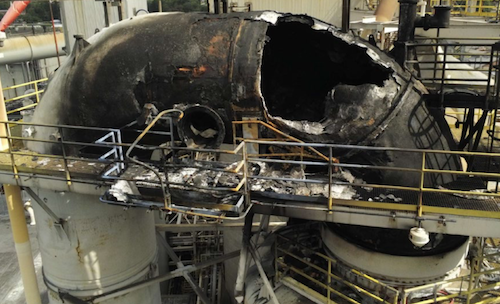
Damage after firefighters extinguished the fire.
Source: CSB
CSB’s investigation identified the safety issues below.
Hot Work Safety. The electric heat gun used to warm the flammable resin could achieve temperatures in excess of the resin’s flash point and auto-ignition temperatures. The electric heat gun came into direct physical contact with the flammable resin when it fell into the resin bucket. Blastco did not recognize the ignition hazard presented by the use of the heat gun, did not inform Evergreen or Rimcor of the heat gun’s use, and did not take adequate action to prevent the introduction of ignition sources into a confined space containing flammable liquids. In addition, while Evergreen’s internal policies defined hot work as “any activity that could serve as a source of ignition,” Evergreen’s contractor orientation materials limited the hot work definition to only “burning, cutting, brazing or welding.”
Pre-Job Planning. Cool ambient temperatures on the night of the incident caused poor performance of the resin Blastco was using to repair the inside surface of the upflow tower. Blastco workers unsuccessfully attempted several means of addressing the problem prior to resorting to warming the resin with a heat gun. Drum heaters, which might have prevented this incident by warming the resin in a drum outside the upflow tower, were not identified in pre-job planning efforts, and Blastco workers were unable to locate them on Blastco’s job trailer. The work also was not performed during the day when temperatures were warmer, which may have eliminated the need to warm the resin.
Confined Space Safety. Evergreen, Blastco and Rimcor treated the upflow and downflow towers as separate and independent confined spaces, even though the towers were connected by a crossover pipe. Blastco failed to terminate the confined space entry when a new hazard, the heat gun, was introduced into the space. There was no coordination between the two contract crews, and no evaluation was made as to whether the simultaneous operations posed a hazard to each other. In addition, Blastco did not effectively evaluate the flammable material hazards presented by its work in the upflow tower, and Evergreen did not ensure its emergency response team was on standby outside the upflow tower while flammable materials were used inside the confined space.
Combustible Materials of Vessel Construction. The five-gallon bucket in which the fire initiated in the upflow tower did not contain enough fuel to sustain the size and duration that the fire achieved during the incident. Evidence shows the upflow tower itself, constructed of combustible FRP, caught fire. This contributed to the spread of smoke and flames to the downflow tower, where the two Rimcor employees were fatally injured.
Cause of Incident
The CSB determined the cause of the incident was the failure by Blastco to effectively evaluate the flammable material hazards presented by its work in the upflow tower and implement controls to prevent the introduction of ignition sources to the work area.
Contributing to the incident was Blastco’s failure to recognize heat guns as a form of hot work that could ignite flammable materials, gaps in Evergreen’s training to contractors on forms of hot work, and poor pre-job planning that allowed Blastco’s work to occur during cold temperatures which were known to make the fiber-reinforced plastic application process difficult, in addition to a lack of Blastco troubleshooting guidance for safely addressing cold-weather resin performance.
Contributing to the severity of the incident were poor confined space safety practices, including Blastco’s and Rimcor’s lack of recognition and control of the hazards of the simultaneous operations, Evergreen’s failure to ensure coordination and the integrity of pre-planning between the two contract companies, inadequate communication between Blastco and Rimcor, and the lack of immediately available emergency services during the hazardous operation involving flammable materials in a confined space. The material of construction of the upflow tower and crossover line also contributed to the severity of the incident, as it was a combustible material that enabled the fire to quickly spread.
The CSB issued the following recommendations as a result of the investigation:
Occupational Safety and Health Administration (OSHA)
- Publish a “Safety and Health Information Bulletin” addressing the hazards and controls when using flammable materials in confined spaces.
- Issue a safety information product (such as a letter of interpretation) addressing the analysis and control of hazards that are not pre-existing but which result from work activities inside permit-required confined spaces.
- Require Owner/Operators to ensure the coordination of simultaneous operations involving multiple work groups, including contractors. Include in the requirement for Owner/Operators to ensure the following activities occur:
–Identification of potential simultaneous operations
–Identification of potential hazardous interactions
–Evaluation and implementation of necessary safeguards to allow for safe simultaneous operations
–Coordination, including shared communication methods, between the simultaneous operations
–Inclusion of emergency response personnel or services in the planning and coordination of the simultaneous operations - As necessary, seek the regulatory authority to promulgate this requirement.
To Evergreen Packaging
- Update all documentation, training, and orientation materials provided to contractors pertaining to hot work to reflect Evergreen Packaging’s internal definition of hot work. The materials should make clear hot work encompasses any method of work that can serve as a source of ignition.
- Develop and implement a formalized and comprehensive Simultaneous Operations (SIMOPs) program addressing planned work occurring close together in time and place to include policies, procedures, hazards reviews, hazards abatement, training, and shared communication methods, to protect employees and contract workers from the hazards posed by simultaneous operations at its facilities.
- Develop and implement a policy that requires the involvement of emergency response personnel in planning and coordination of activities involving the use of flammable materials in confined spaces. In the policy, require that emergency response personnel be stationed directly outside the confined space in which flammable materials are used. Ensure that the emergency response personnel are appropriately trained and equipped for confined space entry, confined space rescue and fire response.
- To Universal Blastco
- Update the Universal Blastco hot work policy and employee training program to specifically identify the use of heat guns as hot work. The policy and programs should make clear that hot work encompasses any method of work that can ignite a fire and not just spark- or flame-producing work methods.
- Develop a formalized troubleshooting guide and/or standard operating procedure for the usage of resin and fiberglass matting in FRP operations.
- The procedure should direct employees on acceptable means of addressing cold-weather resin performance.
- Develop a policy and standard operating procedures for the proper use of heat guns in FRP operations.
Click here for more details on the report.