
To that end, Sandia National Laboratories inked memoranda of understanding with Texas A&M University; the University of California, Berkeley; North Carolina State University and the University of Texas at El Paso and is finalizing agreements with Arizona State University and the University of Washington.
When those agreements end up signed, Sandia will have formal ties with 27 universities, including 13 minority serving institutions.
But Sandia won’t meet its obligations just by hiring staff.

Partnering with Universities
“Partnering with universities keeps Sandia science at the state of the art and enables us to do more research for our national security mission than we can on our sites alone,” said Diane Peebles, Sandia’s senior manager of academic programs.
The partnerships take many forms. Research collaborations can range from nuclear science and nonproliferation to climate change, quantum computing, cybersecurity, pandemic resiliency and biodefense.
Additionally, “A memorandum of understanding (MoU) aligns the leadership at each institution to invest and deeply engage to help each other in numerous ways beyond just collaborative research,” said Ken Patel, Sandia’s campus partnership manager for Purdue University and UC Berkeley. “The MoU is more strategic and thinks long term rather than project specific. It helps to meld the institutional synergies and leverage the unique differences, so that we can become more effective partners.”
Patel said the agreements also streamline other activities – such as when Sandia staff teach university courses or when the laboratory arranges workspace for a visiting faculty – and simplify financial agreements.
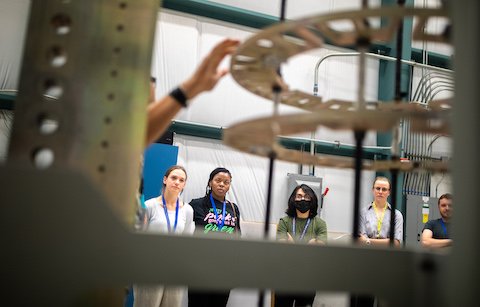
Students from left to right, Jacqueline van Zyl and Amari Murry from Georgia Tech, Jorge Jimenez from the University of Illinois, Caroline Flesch from Ripon College, and Cameron Shock from Michigan Tech, are shown an attachment for Sandia National Laboratories’ superfuge by test operations engineer Orlando Abeyta during a tour in June.
Source: Craig Fritz, Sandia National Laboratories
The new memoranda expand existing relationships Sandia uses to carry out its national security programs, ranging from research to recruiting and workforce development.
A longstanding collaboration with UC Berkeley professor Jennifer Doudna, who shared the 2020 Nobel Prize in chemistry for her work on CRISPR-Cas9, a way to edit DNA, has helped Sandia and the Department of Energy design safeguards for genetically engineered organisms. The project helps ensure the organisms do not cause unintended, negative environmental and social impacts. Sandia also works with UC Berkeley on nuclear deterrence, global security and quantum information science projects.
Texas A&M and Cybersecurity
Texas A&M and Sandia have had research relationships in hypersonics, global security research, materials science and, more recently, infrastructure cybersecurity. The relationship is further strengthened by Texas A&M-RELLIS, the technology and testing research hub of the Texas A&M University System that facilitates collaboration and educational opportunities in areas such as autonomous and connected vehicles, robotics, roadside safety and physical security, large-scale infrastructure, smart power grids and water systems, and the internet of things.
The expansion of partners also means that more college students than ever before will have opportunities to participate in national security projects with Sandia starting this fall. A formal relationship with a university enables Sandia to create student jobs through Laboratory Directed Research and Development (LDRD) funding provided to schools that can be used to pay for research stipends.
“When we get students involved in that LDRD research, then those students get to see what Sandia projects look like, they get to work directly with Sandia principal investigators and they get a poster session at the end of each fiscal year to present their work,” Peebles said.
“It’s a chance to make a serious impact in national security in a way that they probably wouldn’t have at other institutions,” Peebles said.