
Floating offshore wind (FOSW) is one of the most promising clean energy technologies with a potential market worth nearly $16 billion – but science and technology solutions must continue to occur to help reduce the cost of developing, deploying, and maintaining these complex systems.
In a move toward getting these systems moving in the right direction, sensing technologies consisting of fiber-optic cables, which could be installed on FOSW structures planned off the California coast are now in development from scientists at the Department of Energy’s Lawrence Berkeley National Laboratory (Berkeley Lab).
In collaboration with experts in materials science, engineering, geophysics, and FOSW developers from around the world, Berkeley Lab Scientist Yuxin Wu is developing solutions to reduce the cost of FOSW development and deployment, while minimizing potential environmental impacts.

“We want to leverage scientific innovation by co-designing structural materials that are better able to withstand harsh marine environments and extreme weather events,” Wu said. “And we want to add distributed fiber optic sensing to FOSW systems to enable systems to self monitor in real time for potential problems, a capability that could prolong a system’s lifespan and lower operating and maintenance costs.”
The idea of using fiber-optic sensing is a new concept for offshore.
“A fiber cable has a glass core that allows you to send an optical signal at the speed of light; when there is any vibration, strains, or changes in temperature of the material that is being monitored, that information will be carried in the light signal that is scattered back,” Wu said. “When attached to or embedded within the wind turbine structure, this gives it a ‘nervous system’ which allows it to ‘hear’ and ‘feel.’ The fiber is able to monitor surrounding acoustic signals, such as whale calls, which can help scientists monitor potential impacts to large marine mammals from FOSW operations.
“We’ve been testing the deployment of this sensing technology to structural components – such as towers and turbines – to monitor physical and mechanical conditions experienced by the structure itself, like temperature or strain. Our research so far has focused on testing fiber optics on the tower and gearbox, some of the most expensive components where there is benefit to identifying damage before it leads to problems.”
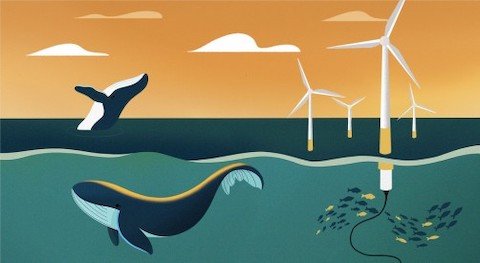
Fiber-optic sensing is now capable of monitoring surrounding acoustic signals, such as whale calls, which llows scientists to monitor how floating offshore wind operations might impact large marine mammals.
Soure: Jenny Nuss/Berkeley Lab
To that end, fiber optics can open more eyes to how it is possible to reduce costs.
“By revealing what is happening within a FOSW system in real time, fiber-optic sensing gives us the knowledge needed to develop more resilient, cost-effective materials at the system level,” Wu said. “Designing FOSW systems at lower cost and to withstand harsh marine environments requires cutting-edge materials science combined with computing science to produce better materials and to effectively simulate how the materials perform. Materials can be developed to give the structures self-healing capabilities; for example, seawater intruding into a crack in concrete triggers reactions to seal the crack without interventions.”
Understanding and simulating all types of conditions offshore is key to the development of the sensing capabilities.
“Digital twins are representations of structures made using advanced computer modeling, often jointly with real-time monitoring data, that scientists can use to control, simulate, and monitor how the FOSW system would respond to different weather or marine conditions,” Wu said. “For example, we can simulate conditions of a hurricane and see exactly how the system would function under this extreme weather – right from our desktop computers. With real-time data feeding into the digital twins, system response to actual ‘on-the-water’ field conditions can be monitored to support decision-making, for example when to send a crew to conduct system inspection. This could significantly reduce costs by avoiding unnecessary trips, and by allowing proactive maintenance of the system before larger, expensive failures.”
Moving forward Wu sees collaboration with multiple industry sectors will help reduce costs and move forward.
“The Department of Energy’s floating offshore wind earthshot has an ambitious goal of 70 percent cost reduction by 2035. This requires a system-level approach that optimizes all steps through the entire lifecycle of FOSW from material design, structural construction, deployment, operation, and maintenance. Partnering with institutions and industries with different expertise allows us to efficiently develop these new and complex technologies that can help shift the nation’s energy economy to one built on clean, renewable sources.”