
To that end, a research team has developed a multifunctional membrane that can simultaneously generate electricity while purifying wastewater into drinking water.
A team from the Korea Institute of Science and Technology (KIST) developed an advanced membrane that can simultaneously provide drinking water and generate continuous electricity from various water resources, such as sewage/wastewater, seawater, and groundwater.
The membrane is designed to purify wastewater by controlling the direction of the water flow. Water flowing perpendicularly to the membrane generates direct current by the movement of ions along the horizontal direction.

The membrane can reject more than 95 percent of the contaminants of sizes less than 10 nm (one hundred-millionth of a meter). Hence, microplastics and heavy metal particles in wastewater can be removed, and continuous electricity can be generated for more than 3 hours with only 10 µl (microliter) of water.
Since the membrane can be manufactured using a simple printing process without size restrictions, it has a high potential to be commercialized due to low manufacturing costs and processing time.
The research team, led by Dr. Ji-Soo Jang’s team from the KIST Electronic Materials Research Center and Prof. Tae-Gwang Yoon’s team from the Department of Materials Science and Engineering at Myongji University, is currently conducting follow-up research to generate electricity while improving the water quality of wastewater to the level of drinking water by developing the membrane for an actual factory.
“As a novel technology that can solve water shortage problem and produce ecofriendly energy simultaneously, it also has great potential applications in the water quality management system and emergency power system,” Jang said.
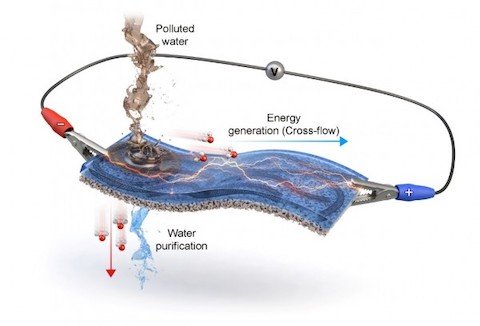
Schematic for the operation of the electricity generation and water purification membrane developed by KIST-Myongji University joint research team.
Source: Korea Institute of Science and Technology