
Unlike previous methods, which require costly recalculations, this approach streamlines the analysis, making it practical even for vast, complex networks, said researchers at the Complexity Science Hub (CSH) in a paper.
“What makes this discovery particularly exciting is its universal applicability,” said first author Vito D.P. Servedio, a senior researcher at CSH. “It extends methods previously limited to economic analysis into a universal tool that works for all types of networks.”
“This is a crucial capability for both protecting critical infrastructure and understanding how networks might fail,” Servedio said.

Help Secure Supply Chain
The tool has far-reaching practical applications.
The concept of “fitness centrality” could work in supply chains to determine which companies are vital to the network’s functioning, enabling better risk management and more resilient planning, said co-author Giordano De Marzo.
“In ecological networks, it could help conservationists identify which species are most critical to maintaining ecosystem stability,” said De Marzo, a postdoc researcher at the University of Konstanz and a research fellow at CSH.
For cybersecurity experts, it provides a new way to identify vulnerable points in computer networks that need extra protection, said co-author Emanuele Calò, a visiting student at CSH.
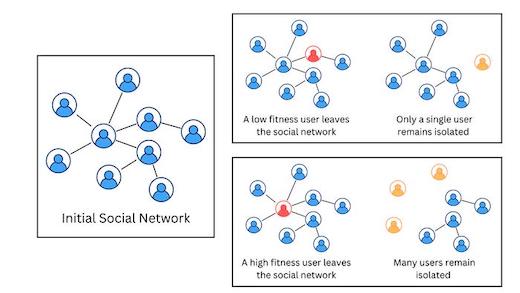
Fitness centrality is an approach that can identify the most vital nodes in a network and pinpoint weak points.
Source: Complexity Science Hub
“In transportation networks, such as airline or road systems, recognizing key nodes, such as airports, and intersections, helps maintain connectivity of poorly connected areas and optimize response strategies during disruptions,” said Calò, a PhD student from the IMT School for Advanced Studies Lucca. “Additionally, identifying essential employees and teams in collaboration networks within companies helps prevent communication breakdowns and ensure workflow continuity.”
“A key advantage of this method is its computational efficiency. Unlike other approaches that require recalculating network quantities after each node removal, this method computes fitness values only once at the initialization phase,” Servedio said. “This makes it practical for analyzing large networks where alternative methods would be prohibitively slow. The method is particularly valuable when recalculating network properties after node removal is unfeasible, such as in law enforcement operations targeting organized criminal networks.”
In test cases, the approach consistently outperformed existing methods by about 15 percent in identifying crucial nodes whose removal would most disrupt the network. “One could say our method produces 15 percent more network splinters,” Servedio said.
Isolated Nodes
“There are many ways to disrupt a network, depending on your goal. If you aim to split a network into large communities, betweenness centrality is a suitable method. In contrast, our fitness centrality approach disrupts networks like a grater does to cheese, breaking them into small splinters – tiny clusters or isolated nodes with no connections. For example, in a terrorist network, splitting it into large parts could result in losing oversight of those groups. Instead, the goal would be to isolate as many individuals as possible,” Servedio said.
As often happens in science, methods originally developed for a specific discipline or question can also prove useful in other fields. In this case, this was also true.
“Fitness centrality” came from key concept of Economic Fitness Complexity (EFC), a measure originally developed to explain and predict the economic development trajectories of countries, cities, and regions.
However, the existing algorithm ended up limited to bipartite graphs, which are mathematical models for relationships between elements of two sets.
“It became unusable even with the smallest deviations from this bipartite structure – which is problematic, as real-world networks typically do not consist of just two groups,” said co-author Alessandro Bellina, from Sapienza University of Rome. “We’ve taken a method originally developed for economic analysis and transformed it into a tool to understand any type of network system.”