
These devices include wireless equipment, autonomous machinery, wearable sensors, and security systems. With their intricate structures and properties, there is a big need to scrutinize them closely to assess their safety and utility and rule out any potential defects, while at the same time not damaging the device during inspection.
Terahertz (THz) imaging, based on radiation with frequencies between 0.1 and 10 THz, is one such non-destructive method rapidly gaining popularity owing to its high penetration, resolution, and sensitivity.
That is where the team of researchers from the Tokyo Tech, led by Associate Professor Yukio Kawano, comes in. They addressed the issue by designing a flexible and free standing THz sensor array that can image blind ends of irregularly shaped objects.

“Given the diversity in shapes, structures, and sizes of test objects, the camera design and sensor must be adapted to conform to different configurations,” Kawano said . “In our study, we have developed a simple and cost-effective fabrication method for generating THz cameras with adaptable shapes.”
The scientists knew the material used in such sensors must have good absorption in the THz spectrum along with a high efficiency of converting emissions into detectable electric signals. For this reason, they selected carbon nanotube (CNT) films, which also possess good mechanical strength and flexibility.
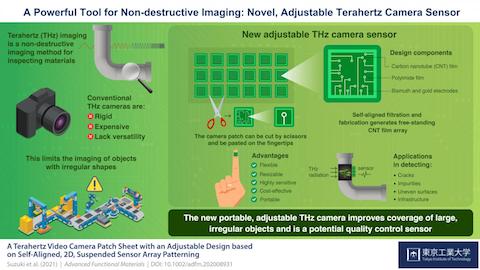
A 2D THz camera patch can ease the restrictions pertaining to the shapes and locations of measurement samples. The proposed technology can potentially create a new research direction on all-around sheetsensors by incorporating THz, thermal, strain, and biochemical sensors through the self-aligned filtration process.
Source: Tokyo Tech
They passed the CNT solution through a polyimide film with laser induced slits and a membrane filter using a vacuum. Upon drying, the CNT solution remained as a free standing suspended structure between the layers of the patterned polyimide film. Further, they developed a simple fabrication process based on the self-assembly of CNT film array and its ability to form electrodes at both ends. For this, they evaporated metal electrodes over the patterned polyimide film.
Together, these processes generated a THz camera patch sheet with multiple cameras. Interestingly, the structure of the suspended CNT film could end up modified by altering the filtering conditions and thus the frictional force, making the process customizable.
Moreover, an operator could cut the patch sheet with scissors into smaller portable and wearable sensors that can attach to the surface of the test object for better coverage. The researchers were able to demonstrate its industrial applications by detecting and visualizing cracks, impurities and uneven coating of polymers in a resin and by detecting sludge within a bent pipe, thus underscoring the potential of the camera in quality control operations.
“Our patch camera can be easily set up for imaging of large and unmovable objects,” Kawano said. “The unique 2D THz camera patch can ease restrictions pertaining to the shapes and locations of objects, contributing significantly to non-destructive monitoring sensor networks.”