
As convergence of information technology (IT) and operational technology (OT) becomes stronger, these trusted access pathways can expose critical operations to risks that conventional perimeter defenses may not adequately address.
A new study reviews how insider and external threats can affect power transmission systems differently. Researchers from Michigan Technological University and the University of Michigan-Dearborn found the key distinction is not simply how an attack begins, but how easily it can progress through the systems and organizations that support grid operations.
It could complement established requirements, including the North American Electric Reliability Corporation Critical Infrastructure Protection standards, by providing a probabilistic perspective on risk alongside compliance-based evaluation.

Insiders Bypass Barriers
“External attackers may need to overcome multiple barriers to reach sensitive operational systems,” said Roman Sidortsov, Associate Professor of Energy Policy Department of Social Sciences, Michigan Technological University. “Insiders, or attackers who gain assistance from people with legitimate access, may be able to exploit existing privileges and knowledge of system operations to bypass some of these barriers.”
In the researchers’ model, such attacks can reach high-impact system states through fewer, more probable transitions. This means fewer observable attack steps do not necessarily indicate lower risk.
The team’s findings highlighted a limitation of relying on perimeter protection and procedural compliance alone.
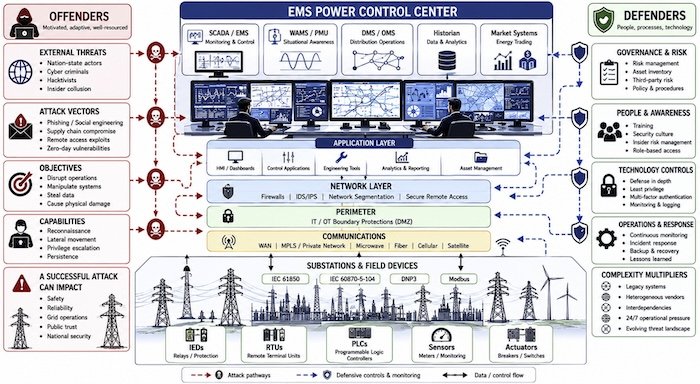
A new study reviews how insider and external threats can affect power transmission systems differently.
Source: Science Direct
“Cybersecurity risks also depend on how access is granted and used, how organizations manage trusted relationships, and how technical systems are connected,” Sidortsov said. “An attack that begins with a compromised account or trusted access pathway may have consequences beyond the initially affected system as it moves across interconnected IT and OT environments.”
To examine how different safeguards affect these risks, the researchers simulated several cybersecurity measures, including network segmentation, privileged access workstations, intrusion detection and security information and event management, and secure firmware validation.
“Under balanced risk weighting, zero-trust segmentation achieved the lowest normalized defender objective among the evaluated policies, improving on the baseline by 7.6 percent,” said Lawrence Dilworth, graduate research assistant at Department of Electrical and Computer Engineering at Michigan Technological University. “It also reduced modelled cyber-compromise exposure by 68.55 percent. Privileged access workstations had a different benefit, reducing modelled cyber-physical coupling exposure by 45.58 percent.”
Lowered Compromise Likelihood
However, no single measure substantially reduced all the major risk dimensions considered in the simulations. Some measures lowered the likelihood of cyber compromise while leaving greater residual risk associated with the propagation of attacks into more consequential states. The preferred measure also varied with the assumed mix of external, insider and supply-chain threats.
“The results suggest that protecting power grids requires more than selecting one leading security control: Safeguards need to address different stages of an attack, from restricting access and lateral movement to detecting intrusions, containing their spread and supporting recovery,” Dilworth said.
“The simulations illustrate how the effectiveness of cybersecurity measures can depend on who is attacking and how an attack may progress,” Sidortsov said. “For power grid operators, the central implication is that trusted access deserves explicit attention in security planning. A layered approach that combines access controls, network segmentation, monitoring and recovery measures appears better suited to addressing varied threat pathways than reliance on perimeter defenses or procedural compliance alone.”
Click here to download and review the study.