
Virtual haptic implementation technology, also known as tactile rendering technology, refers to the methods and systems that simulate the sense of touch in a virtual environment. This technology aims to create the sensation of physical contact with virtual objects, enabling users to “feel” textures, shapes, and forces as if they were interacting with real-world items, even though the objects are digital.
The technology is seeing increasing uses in the realms of virtual reality (VR) and augmented reality (AR), where it ends up used alongside visual and auditory cues to bridge the gap between the virtual and physical worlds.
Next Generation Technology
Notably, electrotactile systems, which generate tactile sensations through electrical stimulation rather than physical vibrations, are emerging as promising next-generation tactile rendering technologies.

The sensation of touch ends up mediated by mechanoreceptors, which are tactile sensory cells located in the skin that transmit tactile information to the brain in the form of electrical signals. Electrotactile systems artificially generate these electrical signals, thereby simulating the sense of touch. It is possible to create precise and varied tactile experiences by adjusting current density and frequency.
Despite their potential, existing electrotactile technologies face challenges, particularly in safety and consistency. Variations in skin contact pressure can lead to unstable tactile sensations, and the use of high currents raises safety concerns. To address these issues, the IBS research team developed a Transparent Pressure-Calibratable Interference Electrotactile Actuator (TPIEA).
TPIEA comprises two main components: An electrode section responsible for generating electrotactile sensations and a pressure sensor section that adjusts for finger pressure.
Researchers greatly reduced the impedance of the electrode by applying platinum nanoparticles to an indium tin oxide-based electrode. This not only decreased impedance compared to conventional electrodes but also achieved a high transmittance of 90 percent. The integrated pressure sensor ensures users experience consistent tactile feedback regardless of how they touch the display.
Moreover, the research team conducted a Somatosensory Evoked Potential (SEP) test to quantify tactile sensations.
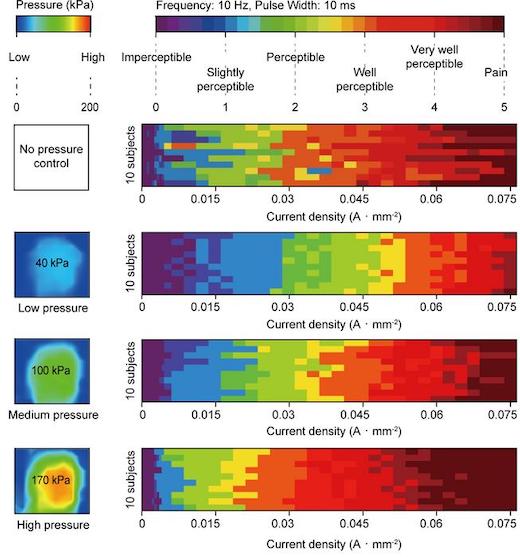
The variations in electrical tactile intensity in relation to current density end up examined under conditions of pressure compensation and in its absence. In the absence of pressure compensation, no discernible pattern emerges in the tactile sensations reported by users. Conversely, when pressure is uniform, the alterations in tactile sensations manifest consistently. It is evident when the pressure exerted by the fingers is substantial, a heightened intensity of tactile sensation ends up perceived even at lower current levels.
Source: Institute for Basic Science
Standardize Tactile Sensations
By examining the responses of the user’s somatosensory system to variations in the current and frequency of electrotactile stimulation, they were able to quantitatively differentiate and standardize tactile sensations. The team successfully implemented over nine distinct types of electrotactile sensations, ranging from those resembling hair to those resembling glass, depending on the current density and frequency of the electrical stimulation. The team further demonstrated the TPIEA could integrate with smartphone displays to reliably produce complex tactile patterns.
Additionally, the research introduced interference phenomena into the realm of electrotactile technology. The interference phenomenon pertains to the alterations in frequency and amplitude that occur when two electromagnetic fields overlap. This allowed the researchers to elicit the same intensity of electrotactile sensation with a current density that is 30 percent lower than previously required and to achieve an approximate 32 percent enhancement in tactile resolution. This research demonstrates the highest level of tactile resolution among current electrotactile technologies, including the Teslasuit.
“Through this electrotactile technology, we can effectively integrate visual information from displays with tactile information,” Jang-Ung said. “We anticipate that the findings of this research will significantly enhance the interaction between users and devices across various AR, VR, and smart device applications based on interference stimulation.”