
The first quarter growth is explained by an unusual spike in January which accounted for 43 percent of all attacks in the quarter, said researchers at Kaspersky.
In early 2021, people were still working remotely and spending their leisure time at home. Therefore, cybercriminals conducted DDoS attacks against entities that users need more, like telecom providers, so their clients experienced issues with their Internet connection or online gaming sites. Despite the remaining attention on such resources, statistics show the overall DDoS situation is becoming stable.
The drop in attacks compared to the same quarter last year was the result in the abnormal activity at the beginning of 2020, researchers said. Due to a sudden shift to remote work, corporate VPN gateways and web resources, such as mail or corporate knowledge bases that were previously available only inside an organization, became a target for DDoS attacks. Within the year, businesses mostly implemented protection for these parts of IT infrastructure. Given this, attacks against these web assets may have become less effective, and the number of DDoS attacks dropped, so by February and March 2021, the number of attacks returned back to a pre-lockdown benchmark.
January this year stands out in terms of the number of DDoS attacks. Statistics from Kaspersky DDoS Intelligence system that intercepts and analyzes commands received by bots from command and control servers highlighted this spike. For instance, on January 10 and 11, the number of registered attacks exceeded 1,800 and for several days in the month it reached more than 1,500.

There were two new botnets discovered in the first quarter. FreakOut malware, discovered in January, attacks Linux devices, according to the report. Cybercriminals exploited several critical vulnerabilities in programs installed on victim devices, including CVE-2021-3007. Botnet operators use infected devices to carry out DDoS attacks or mine cryptocurrency.
Another active bot focused on Android devices with the ADB (Android Debug Bridge) debug interface. The botnet was dubbed Matryosh (from the Russian word matryoshka — nesting doll) due to the multi-step process for obtaining the C&C address. It is not the first bot to attack mobile devices through a debug interface. This loophole was previously exploited by ADB.Miner, Ares, IPStorm, Fbot, Trinity, and other malware.
“In general, the first quarter of 2021 was rather quiet, apart from surge in DDoS activity in January,” said Alexey Kiselev, business development manager on the Kaspersky DDoS Protection team. “That surge may have been caused by a fall in cryptocurrency prices that made some malefactors repurpose infected devices in botnets to send junk traffic instead of mining currency. So, despite an overall decline in Q1, we recommend protecting web resources from DDoS attacks. Because, as we can see, cybercriminals driven by financial motives can easily change their tactics depending on the circumstances.”
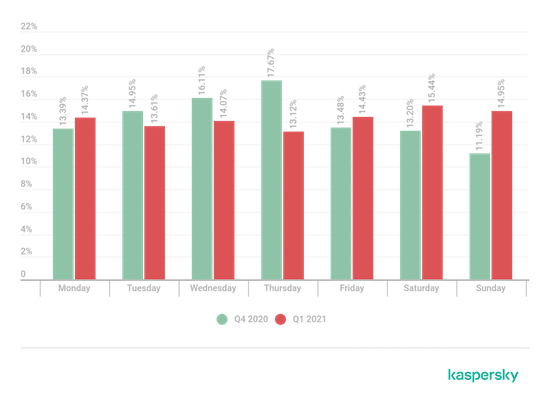
Distribution of DDoS attacks by day of the week, Q4 2020 and Q1 2021.Source: Kaspersky
To stay protected against DDoS attacks, Kaspersky experts offer the following recommendations:
- Maintain web resource operations by assigning specialists who understand how to respond to DDoS attacks.
- Validate third-party agreements and contact information, including those made with Internet service providers. This helps teams quickly access agreements in case of an attack.
- Implement professional solutions to safeguard your organization against DDoS attacks.
Click here to view the full report.