
These quantum devices are high-performance diamond sensors that can end up manufactured using conventional glass fibers.
By embedding micron-scale diamond particles within the cross section of a silicate glass fiber, the team from RMIT University and University of Adelaide, demonstrated the use of a robust material capable of sensing magnetic fields.
Diamond is one of the front runner technologies for quantum magnetic field sensing, with applications as diverse as brain scanning, navigation and mineral exploration.

But, diamond particles need to end up viewed through high-end microscopes that aren’t suited for use over an extended period or in the field.
The team had been working to get around this issue for a decade, said University of Adelaide Deputy Director of the Institute for Photonics and Advanced Sensing, Heike Ebendorff-Heidepriem.
“But because diamond burns at high temperatures, we’ve been limited in the glasses that we can use,” she added.
The team has learned quit a bit from these “soft glasses,” but these glasses are non-standard and not as good at guiding light as conventional silica fibers, such as those used in the National Broadband Network.
That is where Cunningham comes into the picture.
She was making art using nanoparticles to show how light moves through glass and was fascinated by the diamonds that were used by Heike and her colleagues in her research.
“We gave Karen some of our larger diamonds to see how they worked,” said RMIT School of Science’s Professor Brant Gibson.
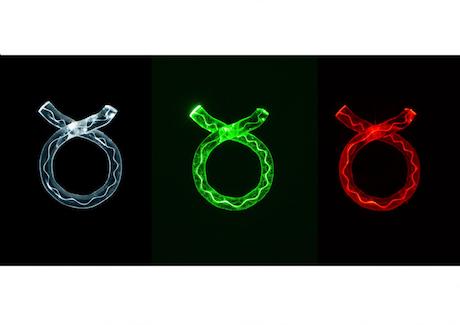
Three glass rings by artist Karen Cunningham. Colored light reveals the internal line of the diamond used in the artwork.
Source: Michael Haines Photography
The diamonds he gave Karen were around one micron in diameter, which is 50 times smaller than the width of a human hair.
“For most of our work, these diamonds are just too big, so we use them mainly for testing,” he said.
Incredibly, the diamonds survived Karen’s glass blowing, and were part of her exhibition at JamFactory in Adelaide, in 2017.
“For us, it was the lightbulb moment and we knew we could make diamond sensors in more conventional glass fibers,” Heike said.
To go from Karen’s art to prototype sensors took another three years of testing and fabrication, Bai said.
“It always takes hard work to go from the idea to the product, but I’m so excited by what we’ve achieved, and even more excited by where this new quantum sensor can take us,” she said.