
To that end, an international collaboration of scientists used global power plant data to demonstrate an integrated water-carbon management framework that bridges the gap to coupling diverse water carbon-mitigation technologies with other methods.
Thermal electric power generation uses substantial amounts of freshwater primarily for cooling of power plants, amounting to 40 to 50 percent of the total water withdrawal in the U.S. and 40 percent in Europe. Meanwhile, power generation accounted for approximately 36 percent of the energy-related carbon dioxide (CO2) emissions across world economies in 2019.
Consequently, the power sector has a high dependence on freshwater resources and demonstrates intrinsic water-carbon interconnections that have critical implications on reliable electricity output and energy security, particularly under climate change.
In a paper on the subject entitled, “Global assessment of the carbon-water tradeoff of dry cooling for thermal power generation,” researchers conclude such integrated planning is crucial to address the complex interactions between water and energy systems. The team constructed a global unit-level framework to assess the impact of dry cooling – a vital water mitigation strategy – alongside alternative water sourcing and carbon capture and storage (CCS) under different scenarios.

The research team collected unit-level power plant data, which included basic power generation unit information such as fuel and engine types, installed capacity, cooling technologies and other details, said Gang He, PhD, a co-author of a paper on the subject and assistant professor in the Department of Technology and Society at Stony Brook University in New York. Then they estimated carbon emissions and water withdrawal based on known emission factors at plants and water intensity by the cooling technologies, fuel types and local meteorology.
He said from their global data the CO2 emission and energy penalty from dry cooling units were location and climate specific, and ranged from 1 to 15 percent of power plant output. Additionally, efficiency losses were high under climate changes scenarios.
On a positive note, the team discovered potentially promising solutions to alleviate water scarcity around the power plants – such as increasing accessibility to wastewater and brine water that can provide viable alternatives to dry cooling and reduce energy and CO2 penalties.
Additionally, He and coauthors concluded CCS emerged as a valuable tool to offset CO2 emission tradeoffs associated with dry cooling, especially when alternative water sourcing alone is insufficient in certain power plant regions.
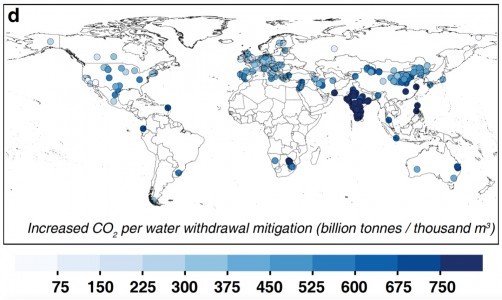
Graphic shows how per unit water saving by dry cooling increases carbon emissions by each power unit globally, a significant issue for example in areas of India.Source: From paper published in Nature Water
However, He stresses the issue is complicated globally, as CCS could demand more energy and thus more emissions, and wastewater could be useful but has its limitations and may not be available near some power plants.
The authors remain concerned about the potentially increasing water-carbon tradeoffs with dry cooling.
“Facing increasing water concerns, dry cooling has been and may continually be promoted as an emerging freshwater mitigation technique in some major economies in the next few decades along with renewable energy transitions,” they said in the paper.
He said the research leading to the paper underscores the urgency of integrated power sector planning in the face of dual water-carbon challenges and “highlights the importance of considering climate-specific factors and interconnected systems to achieve sustainable energy solutions.”