
Compared to the first half of last year, ICS vulnerabilities published by the National Vulnerability Database (NVD) increased by 10.3 percent to 365 from 331, while Industrial Control Systems Cyber Emergency Response Team (ICS-CERT) advisories increased by 32.4 percent to 139 from 105, according to the Biannual ICS Risk & Vulnerability Report, released today by operational technology (OT) security provider Claroty. Add on top of that, over 75 percent of vulnerabilities ended up assigned high or critical Common Vulnerability Scoring System (CVSS) scores.
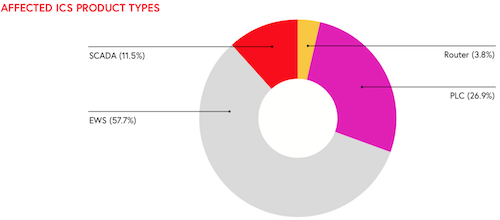
Breakdown of Claroty-discovered vulnerabilities by affected product type
Source: Claroty
Remotely Exploitable
Over 70 percent of the vulnerabilities published by the NVD are remotely exploitable, reinforcing the fact fully air-gapped ICS networks isolated from cyber threats are uncommon, according to the Claroty Research Team report. Additionally, the most common potential impact was remote code execution (RCE), possible with 49 percent of vulnerabilities – reflecting its prominence as the leading area of focus within the OT security research community – followed by the ability to read application data (41 percent), cause denial of service (DoS) (39 percent), and bypass protection mechanisms (37 percent). The prominence of remote exploitation has been exacerbated by the rapid global shift to a remote workforce and the increased reliance on remote access to ICS networks in response to the COVID-19 pandemic.
Affected Sectors
Energy, critical manufacturing, and water and wastewater infrastructure sectors were by far the most impacted by vulnerabilities published in ICS-CERT advisories during the first half of this year, the report said. Of the 385 unique Common Vulnerabilities and Exposures (CVEs) included in the advisories, energy had 236, critical manufacturing had 197, and water and wastewater had 171. Compared to the same period a year ago, water and wastewater experienced the largest increase of CVEs (122.1 percent), while critical manufacturing increased by 87.3 percent and energy by 58.9 percent.

Claroty Research Team discovered 26 ICS vulnerabilities disclosed during the first half this year, prioritizing critical or high-risk vulnerabilities that could affect the availability, reliability, and safety of industrial operations. The team focused on ICS vendors and products with vast install bases, integral roles in industrial operations, and those that utilize protocols in which Claroty researchers have expertise. These 26 vulnerabilities could have serious impacts on affected OT networks, because more than 60 percent enable some form of RCE.
For quite a few of the vendors affected by Claroty’s discoveries, this was their first reported vulnerability. As a result, they proceeded to create dedicated security teams and processes to address the rising vulnerability detections due to the convergence of IT and OT.
Click here to register for the complete report.