
On May 16, 2020, the fatality occurred when a Fluid Crane and Construction (FCC) crew was in the process of replacing grating on the casing deck of Ewing Bank (EW), Block 826, Platform A, operated by Fieldwood Energy LLC.
Fieldwood contracted FCC to replace the grating on the casing deck after April 2018 and November 2019 Level I Surveys of the platform revealed a grade of “C-Poor” on approximately 30 and 60 percent of the grating on the casing deck, respectively, according to a report from the Bureau of Safety and Environmental Enforcement (BSEE).
Fieldwood conducted its own audit of the platform in December 2019. To address the findings, the casing deck was placed out of service until all of the grating could be replaced. Hard barricades placed at both stairways were used to access the deck.
Morning Safety Meeting
On May 16, personnel on the platform gathered for the morning safety meeting at 6 a.m. to discuss the day’s jobs, according to the BSEE report. The construction crew planned to complete the previous day’s job of repairing grating on the casing deck, which had been delayed due to weather issues. The Job Safety Analysis (JSA) the construction crew discussed during this meeting copied the job steps used from the previous day’s grating repair JSA.

At 6:30 a.m., the safety meeting concluded, and the construction crew proceeded to the casing deck to begin the process of changing the grating. The construction crew for this task consisted of a fitter, a welder, two riggers (one of whom was the victim), and a scaffolding builder who acted as a fire watch.
When the fitter, the welder, and two riggers entered the barricaded casing deck, they began staging the tools needed to prepare the old grating for removal: A torch, chipping gun, hammers, metal saw, etc. Crew members said during interviews they had previously staged their fall protection equipment, but did not put it on, even though they discussed utilizing fall arrest systems during the morning safety meeting.
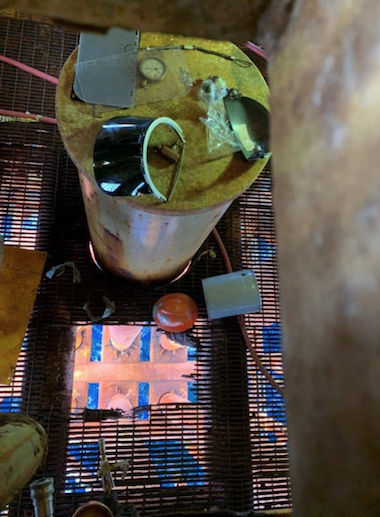
Hole through which the victim fell at the Fieldwood Energy platform off the coast of Louisiana in the Gulf of Mexico.Source: BSEE
The fitter directed the welder to begin “ripping” the old grating (the process of cutting the grating along its length) while he set up hoses for the torch. The Person-in-Charge (PIC) and construction manager then summoned the rigger and victim to the fuel gas scrubber on the production deck to tighten a hammer union. During their absence, the welder continued ripping the area where the victim was previously working.
At 7:30 a.m., after the rigger and victim returned to the casing deck, again without donning their fall protection, the section of grating on which the victim stood parted. The fire watch witnessed the victim partially fall through the grating, and attempted to alert personnel on the casing deck, to no avail. The fire watch then left his post to alert all personnel on the platform about the incident via the GAI-Tronics intercom. By the time the fire watch made the announcement, the victim had fallen approximately 50 feet to the +10 deck.
Response Plan
Following the announcement, personnel initiated the fall response plan. A medic from another platform arrived at EW 826 A, where he found the victim without a pulse, unresponsive, and with no detectable signs consistent with life. An Era Search and Rescue flight then transported the victim to Houma, Louisiana.
BSEE convened a panel team to investigate the incident that resulted in the fatality. The panel, comprised of BSEE professionals, identified causes that may have contributed to the incident. The panel also identified recommendations to further promote safety, protect the environment, and conserve resources on the U.S. Outer Continental Shelf (OCS).
The panel identified the following as probable causes of the incident:
- Fieldwood failed to maintain all walking surfaces on the facility in a safe condition.
- Fieldwood failed to ensure FCC’s Safe Work Practices (SWPs) met or exceeded their own SWPs.
- Supervisors failed to fulfill their intended responsibilities within the relevant, established SWPs.
- Personnel performing the job failed to adhere to the requirements of the JSA.
The panel also identified the following as contributing causes of the incident:
- The JSA process was not controlled.
- Construction crew members followed the instructions of personnel who were not in a position of authority.
- Complacency at the jobsite allowed for unnecessary risk exposure.
- The fire watch either did not have or did not use a personal communication radio to convey to the construction crew and other platform personnel that the victim was in danger in a timely manner.
The following list contains some of the key recommendations identified as a result of the investigative findings:
- All facility walking and working surfaces should be regularly inspected and maintained to ensure they are in a safe condition.
- Operators must perform an internal review of their contractors’ Safety and Environmental Management System (SEMS) programs to suitably and adequately identify gaps in a bridging agreement. Responsibilities must be clearly assigned. These bridging agreements should be periodically reviewed to ensure continued effectiveness.
- Supervisors should be trained, skilled, and knowledgeable in their assigned duties and responsibilities. They should take an active role in task planning, hazard analysis, and supervision of work.
- JSA training should be refreshed on a periodic basis.
- A clear delegation of authority should be communicated to all personnel.
- Construction crews should be trained on the dangers of compromised grating and the hazards associated with ripped grating.
- Clear signage conveying fall protection requirements should be posted on or near barricades, where necessary.
- Consider entry logs, maintained by a fire (or hole) watch or job site supervisor, that document when specific personnel enter and/or exit barricaded areas.
- Fire (and hole) watches should have personal communication radios for contact with their assigned crew. Also, consider in-ear hearing protection, with radio hookup capability, so construction personnel in loud environments can be alerted to dynamic situations.
- Personnel should exercise Stop Work Authority (SWA) immediately upon notice that proper Personal Protective Equipment (PPE) is not in use and the job is unsafe.
Click here to read the entire BSEE report.