
“Our main result is that we showed that our technique can suppress ELMs while maximizing plasma performance,” said Ricardo Shousha, a graduate student in the plasma control group in Princeton University’s Mechanical and Aerospace Engineering Department which is affiliated with the Department of Energy’s (DoE) Princeton Plasma Physics Laboratory (PPPL). He is also the lead author of a paper on the subject.
Fusion, the power that drives the sun and stars, combines light elements in the form of plasma – the hot, charged state of matter composed of free electrons and atomic nuclei – that generates massive amounts of energy. Scientists are seeking to replicate fusion on Earth for a virtually inexhaustible supply of power to generate electricity.
But because the temperature and density of the two regions are so drastically different, ELM instabilities form along the boundary, much as thunderstorms can form where hot and cold fronts meet. Those instabilities can cause spurts resembling solar flares, gigantic burps of plasma that erupt from the surface of the sun.

When these events occur in tokamaks, they can damage the inner walls and components, requiring the machine to shut down for repairs. The risk is even higher for ITER, the multinational tokamak being built in Cadarache, France to prove the feasibility of fusion as a large-scale and carbon-free source of energy, since that device will create plasma that has vastly more heat and power than current tokamak plasmas do.
So physicists have a dilemma. They want the plasma to be in H-mode, but H-mode leads to instabilities that could damage the tokamak. Shousha and the other researchers focused on using magnetic fields to tamp down the instabilities, a method discovered in 2003. The applied fields reduce instabilities by allowing particles to flow through the boundary. But one side effect is the plasma cools and the fusion reactions become less efficient.
The research team addressed this problem by combining magnets with a feedback system. The combination determines the weakest magnetic field that can suppress the ELMs while minimizing how much the fields degrade the H-mode conditions. “That’s the novel part of our research,” Shousha said.
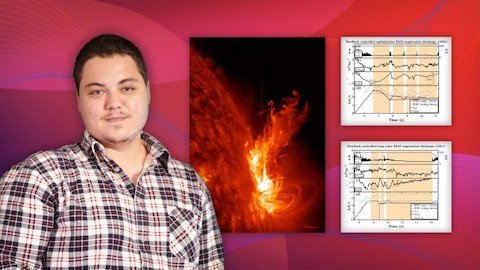
From left: graduate student Ricardo Shousha, an image of solar flares, and graphs showing details of plasma discharges.
Source: Collage courtesy of Kiran Sudarsanan/PPPL
The scientists plan to refine their system so it can detect signals that herald the coming of the ELMs so the magnets can start preventing them before they arise.
“The idea is if we can detect these precursor signals quickly, we can take action before the imminent ELM appears and potentially prevent it,” Shousha said.