
There were record number of 880,418 Internet crime complaints registered with potential losses exceeding $12.5 billion last year, according to a new report just released by the Federal Bureau of Investigation (FBI).
That is nearly a 10 percent increase in complaints received, and a 22 percent rise in losses suffered, compared to the previous year, according to the FBI’s Internet Crime Report 2023. But, as the FBI said in its report, those numbers are conservative regarding cybercrime.
When the FBI infiltrated the Hive ransomware group’s infrastructure, they found only about 20 percent of Hive’s victims reported to law enforcement.

In 2023, ransomware incidents continued to be impactful and costly. After a brief downturn in 2022, ransomware incidents rose again with over 2,825 complaints. This represents an increase of 18 percent from 2022. Reported losses rose 74 percent, from $34.3 million to $59.6 million.
The IC3 received 1,193 complaints from organizations belonging to a critical infrastructure sector affected by a ransomware attack. Of the 16 critical infrastructure sectors, 14 sectors had at least one member fall to a ransomware attack in 2023.
The five top ransomware variants reported to the IC3 were Lockbit, ALPHV/Blackcat, Akira, Royal, and Black Basta.
Cybercriminals continue to adjust their tactics, and the FBI has observed emerging ransomware trends. One was the deployment of multiple ransomware variants against the same victim. Another was the use of data-destruction tactics to increase pressure on victims to negotiate.
In 2023, the IC3 received 21,489 BEC complaints with adjusted losses over $2.9 billion. BEC is a sophisticated scam targeting businesses and individuals performing transfers of funds. The scam occurs when a subject compromises legitimate business email accounts through social engineering or computer intrusion techniques to conduct unauthorized transfers of funds.
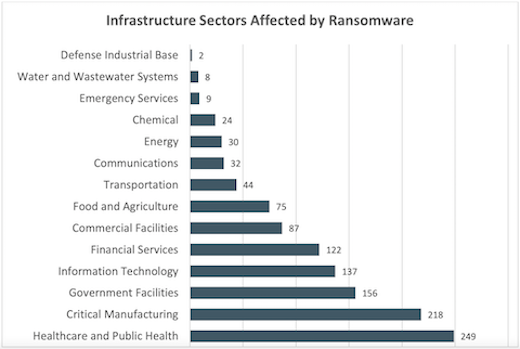
Critical infrastructure sectors affected by ransomware attacks in 2023.
Source: IC3
These BEC schemes historically involved compromised vendor emails, requests for W-2 information, targeting of the real estate sector, and fraudulent requests for large amounts of gift cards. More recently, the IC3 data suggests fraudsters are increasingly using custodial accounts at financial institutions for cryptocurrency exchanges or third-party payment processors, or having targeted individuals send funds directly to these platforms where funds end up quickly dispersed.
Last year also saw wins for law enforcement. The FBI’s mission to help cyber victims and foster partnerships allowed for the continued success of IC3’s Recovery Asset Team (RAT).
RAT streamlines communications with financial institutions and FBI field offices to facilitate the freezing of funds for victims. In 2023, IC3’s RAT initiated the Financial Fraud Kill Chain (FFKC) on 3,008 incidents, with potential losses of $758.05 million. A monetary hold ended up placed on $538.39 million, representing a success rate of 71 percent.
In one case last March, the IC3 received a complaint filed by a critical infrastructure construction project entity in the New York City area of a $50 million loss due to a BEC incident. The RAT immediately sent the Financial Fraud Kill Chain (FFKC) request to the recipient financial institution and froze $44,936,460 in the account. Second-hop information came from the recipient financial institution, and the RAT pursued the secondary wires to two additional recipient financial institutions. FFKC responses from the second wires froze an additional $1,008,526.
Click here for more on the IC3 Internet Crime report.