
That is a reason behind what the Cybersecurity and Infrastructure Security Agency (CISA) wanted to share after it responded to an incident at a U.S. federal civilian executive branch (FCEB) agency following the detection of potential malicious activity.
The incident ended up identified through security alerts generated by the agency’s endpoint detection and response (EDR) tool.
As a result of the incident, CISA identified three lessons learned from the engagement that illuminate how to effectively mitigate risk, prepare for, and respond to incidents: Vulnerabilities did not end up promptly remediated, the agency did not test or exercise their incident response plan (IRP), and workers did not continuously review EDR alerts.
In the incident, CISA discovered cyber threat actors compromised the agency by exploiting CVE-2024-36401 in a GeoServer about three weeks prior to the EDR alerts.

Separate Initial Access
Over the three-week period, the cyber threat actors gained separate initial access to a second GeoServer via the same vulnerability and moved laterally to two other servers.
CISA wanted to point out lessons learned for organizations to mitigate similar compromises:
Vulnerabilities not promptly remediated:
- Cyber threat actors exploited CVE-2024-36401 for initial access on two GeoServers.
- The vulnerability ended up disclosed 11 days prior to the cyber threat actors accessing the first GeoServer and 25 days prior to them accessing the second GeoServer.
The agency did not test or exercise their incident response plan (IRP), nor did their IRP enable them to promptly engage third parties and grant third parties access to necessary resources:
- This delayed certain elements of CISA’s response as the IRP did not have procedures for involving third-party assistance or for granting third-party access to their security tools.
EDR alerts did not end up continuously reviewed, and some public-facing systems lacked endpoint protection:
- The activity remained undetected for three weeks; the agency missed an opportunity to detect this activity earlier as they did not observe an alert from a GeoServer and the Web Server did not have endpoint protection.
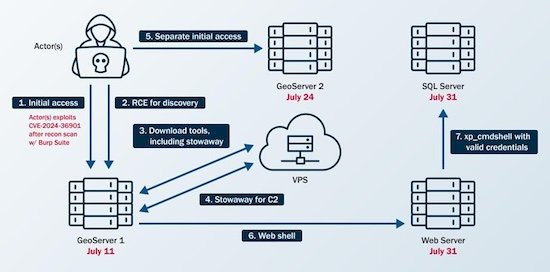
Overview of threat actor activity during an attack scenario.Source: CISA
During the incident response, CISA found cyber threat actors gained access to the agency’s network on July 11, 2024, by exploiting GeoServer vulnerability CVE 2024-36401 on a public-facing GeoServer (GeoServer 1).
Jumped on Vulnerability
This critical vulnerability, disclosed June 30, 2024, allowed unauthenticated users to gain remote code execution (RCE) on affected GeoServer versions. The cyber threat actors used this vulnerability to download open source tools and scripts and establish persistence in the agency’s network.
After gaining initial access to GeoServer 1, the cyber threat actors gained separate initial access to a second GeoServer (GeoServer 2) on July 24, 2024, by exploiting the same vulnerability.
They moved laterally from GeoServer 1 to a web server (Web Server) and then a Structured Query Language (SQL) server. On each server, they uploaded (or attempted to upload) web shells such as China Chopper, along with scripts designed for remote access, persistence, command execution, and privilege escalation. The cyber threat actors also used living off the land (LotL) techniques.
In doing their reconnaissance, attackers identified CVE-2024-36401 in the organization’s public-facing GeoServer using Burp Suite Burp Scanner. CISA detected this scanning activity by analyzing web logs and identifying signatures associated with the tool.
Specifically, CISA observed domains linked to Burp Collaborator – a component of Burp Suite used for vulnerability detection – originating from the same IP address the cyber threat actors later used to exploit the GeoServer vulnerability for initial access.
The cyber threat actors used publicly available tools to conduct their malicious operations. In one instance, they gained remote access to the organization’s network and leveraged a commercially available virtual private server (VPS) from a cloud infrastructure provider.
Used Web Shells
Attackers primarily used web shells on internet-facing hosts, along with cron jobs (scheduled commands that run automatically at specified times), and valid accounts for persistence. CISA also identified the creation of accounts – although these accounts later ended up deleted – with no evidence indicating further use.
Meanwhile, the cyber threat actors attempted to escalate privileges with the publicly available dirtycow tool, which can end up used to exploit CVE-2016-5195. After compromising web service accounts, they escalated their local privileges to transition away from these service accounts (it remains unknown how they escalated privileges).
Click here to view CISA’s entire lessons learned scenario.