
That extreme heat flow, or flux, could seriously damage the walls of the divertor at the heart of the exhaust system and shut down fusion reactions in the doughnut-shaped facilities.
Researchers at the U.S. Department of Energy’s (DoE) Princeton Plasma Physics Laboratory (PPPL) created a plan using liquid lithium to keep the full force of the extreme heat from hitting the divertor and would enable the tokamaks to keep running.
“There will be a warning coming down and if you can catch that and implement a remedy quickly enough you can prevent the event from damaging the divertor wall,” said physicist Masayuki Ono, lead author of a paper that outlines a proposed solution.
Fusion Power
Fusion reactions combine light elements in the form of plasma — the hot, charged state of matter composed of free electrons and atomic nuclei that makes up 99 percent of the visible universe — to generate massive amounts of energy. Physicists around the world are seeking to reproduce and control such reactions to create a safe, clean and virtually inexhaustible supply of power to generate electricity.

The problem arises because the energy stored in the core of the plasma that will fuel future tokamaks is expected to be 1,000 times greater than in facilities used today. If just 1 percent of the stored energy flared out of the core of a future reactor and reached the divertor, the damage could be extensive, Ono said.
Such an event could end up caused by flare-ups like edge-localized modes (ELMs), in which intense bursts of heat can slam into a tokamak’s plasma-facing walls. The proposed remedy, devised with coauthor Roger Raman, a University of Washington physicist on long-term assignment to PPPL, calls for the injection of pellets of lithium, a light silvery metal, into the divertor at the heart of the exhaust region, where the lithium would liquify and radiate strongly. The radiation would spread out much of the extreme heat escaping from the core of the plasma and would minimize the amount striking the divertor wall.
“The idea is to inject light impurities such as lithium, boron, or beryllium into the divertor region so as to radiate away much of the energy,” Ono said. “The trick will be to go in quickly enough to protect the divertor with very little radiation affecting the plasma core. You don’t want to inject too much impurity material — just enough to do the job.”
Researchers currently inject lithium into tokamaks with simple, inexpensive technologies such as gas gun injectors and a system based on paddle wheels that continuously inject a stream of particles. However, Ono and Raman said gas guns tend to inject a load of gas into the vacuum chamber that houses the core plasma, which could cause problems.
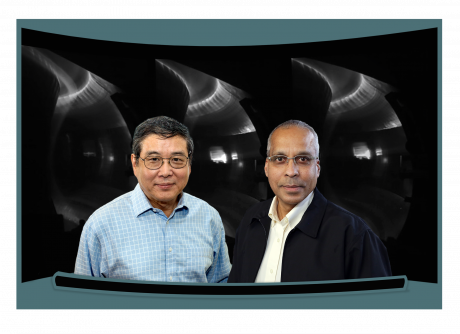
Physicists Masa Ono and Roger Ramen with fast-camera photos of application of liquid lithium behind them.Source: Collage and photos of Ono and Ramen by Elle Starkman/PPPL Office of Communications
The authors propose replacing gas guns with an “electromagnetic particle injector” similar to one that Raman has been developing at the University of Washington. “Avoiding the unnecessary gas load with a controlled fast response time is especially important,” Raman said. The proposed concept would remain in stand-by mode until needed, and then would inject the radiative payload on a fast time-scale.
Sudden Flashes
Warnings of extreme heat flux could come from the sudden flashes of light that heat bursts would create at the edge of the plasma. Such bursts could reach the divertor in about 10 milliseconds. The electromagnetic particle injector would rapidly fire a high-speed projectile into the divertor region to radiate away the onrushing heat flux.
Scientists have previously applied liquid lithium through a different technique to the edge of the plasma in the National Spherical Torus Experiment (NSTX), the forerunner of the National Spherical Torus Experiment-Upgrade (NSTX-U), the current flagship fusion facility at PPPL, and found the metal reduced the peak divertor heat flux. The authors now propose testing the application of lithium with an electromagnetic injector on the NSTX-U when the facility becomes available after completing ongoing repairs.
If this testing is successful, the application could next be tested on future tokamaks such as ITER, the international tokamak under development in France. “This is a tough, challenging problem,” Ono said of controlling extreme heat flux. “It’s a long-range problem and we would be wise to make sure that we have ways to minimize the impact.”
Click here to view the abstract of the paper.