
Goals include increasing fundamental understanding of physical processes that could lead to evaluate chip performance and security, and creating new, ultra-sensitive testing strategies that build on this knowledge.
The University at Buffalo has been selected by the Department of Defense (DoD) to lead the $7.5 million project. The research is funded by the Air Force Office of Scientific Research through the Department of Defense’s (DoD) Multidisciplinary University Research Initiative (MURI).
“Microelectronic circuits are omnipresent in our lives, from our phones, computers, cars and appliances to all kinds of industrial and military equipment,” Prasad said. “We will develop new and dramatically improved ways to ensure that computer chips are authentic and will work as expected. This helps to avoid potentially devastating consequences of either intentional or unintentional malfunction of everything from smartphones to fighter jets.”

Prasad, PhD, is SUNY Distinguished Professor in UB’s departments of chemistry, physics, medicine and electrical engineering, and executive director of UB’s Institute for Lasers, Photonics and Biophotonics (ILPB).
“The semiconductor chip is the heart of electronic products: Your cell phone, computer, tablet, television, even your washing machine – everything’s got a chip in it, and these chips are incredibly complex, miniature circuits. What our project is about is establishing new techniques for probing or monitoring chips so that you can enhance their performance even further,” said Jonathan Bird, PhD, professor and chair of electrical engineering at UB and a co-principal investigator on the grant.
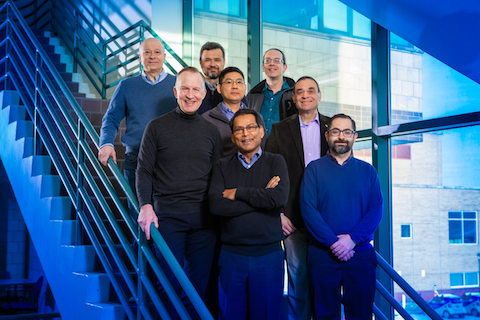
University at Buffalo researchers from multiple departments will play a key role in the new $7.5 million project. Bottom row, from left: Paras Prasad, principal investigator, and Luis Velarde. Middle row, from left: Jonathan Bird, co-principal investigator, Hao Zeng and Mark Swihart. Top row, from left: Andrey Kuzmin, Vasili Perebeinos and Alexander Baev.
Source: Douglas Levere/University at Buffalo
The MURI award supports a variety of studies, including several that aim to exploit the power of quantum science and engineering, Prasad said. Monitoring heat generation, using advanced microscopy to study circuits, and detecting ultra-weak electric and magnetic signals around chips are among many areas of interest.
In a project summary, Prasad and UB colleagues Alexander Baev and Mark Swihart explained the importance of the research by saying ensuring the proper operation and security of microelectronics is essential for modern life. These microelectronic circuits are essentially enormous networks of transistors. A single computer chip may contain up to trillions of transistors, with features as small as 5 nanometers (the width of a human hair is approximately 50,000 nanometers). Probing complex networks of such miniscule devices requires new methods and approaches.”