
“Our aim is to make lighter aircraft more durable while ensuring flight safety,” said Paul Davidson, assistant professor at the University of Texas at Arlington ‘s Department of Mechanical and Aerospace Engineering (MAE),who is leading the $379,500 U.S. Air Force Research Laboratory (AFRL)-funded project.
The practice of using layers upon layers of composite materials laminated together to construct lighter and stronger aircraft is becoming more common across the industry, Davidson said. The Boeing 787, for example, consists of 50 percent composite materials.
Davidson likens delamination to a crack in a car windshield.

“Eventually, that crack grows and grows and makes the vehicle unsafe,” he said. “We’re trying to tell the driver how much time before it becomes unsafe or needs to be strengthened or replaced.”
Davidson said the project has applications for military and commercial sectors.
“The military wants to more finely tune the service life of these composites. They want to know how durable our materials are and how fast can we put the aircraft back into action.”
Field teams will use ultrasound equipment to estimate the damage to aircraft.
A predictive tool developed by Davidson will use that data for computational tests to determine failure risk and operating life of the composite structure. The project also aims to answer the questions of what repairs must be made, how long those repairs will last and whether the aircraft is safe to operate again.
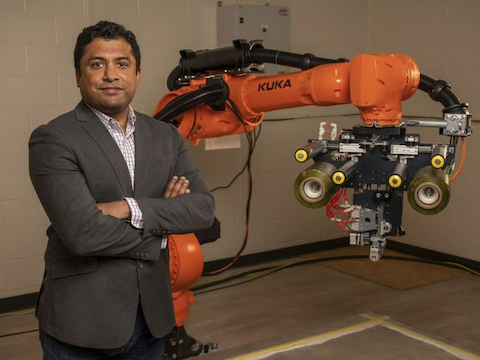
Paul Davidson is leading a team developing a predictive tool to help determine the life, durability and safety of composites used in aircraft manufacturing.
Source: UT Arlington
“The data obtained from the field teams is often incomplete. I’m infilling missing data using machine learning and computational tools to determine composite life, durability and safety,” Davidson said. “We’ll do the impacts and stress tests on the aircraft composites virtually.”
The work will occur in UTA’s Laboratory for Advanced Materials, Manufacturing and Analysis under the AFRL’s Structural Integrity Research Collaborations for Aircraft program.
Erian Armanios, chair of MAE, said Davidson’s project is essential to flight safety, for the military and the public.
“It’s best to virtually extend the range and scale of tests, where loss of aircraft and life is eliminated,” Armanios said. “This project is cost-effective and lifesaving.”