
At the same time, bad guys are using AI to create malware that evades detection by the algorithms widely employed by network security tools. Government agencies, banking institutions, critical infrastructure, and the world’s largest companies and their most used products are increasingly under threat from malware that can evade anti-virus systems, hijack networks, halt operations and expose sensitive and personal information.
But that landscape could soon end up altered because of a technology developed at the Oak Ridge National Laboratory (ORNL) and used by the U.S. Naval Information Warfare Systems Command (NAVWAR) to test the capabilities of commercial security tools.
“One of ORNL’s core missions is to advance the science behind national security,” said Susan Hubbard, ORNL’s deputy for science and technology. “This technology is the result of our deep AI expertise applied to a big challenge – protecting the nation’s cyber- and economic security.”

Smith, who worked in ORNL’s Cyber Resilience and Intelligence Division for six years, created the technology – the adversarial malware input generator (AMIGO) – at the request of the Department of Defense. AMIGO is an evaluation tool for a challenge issued by NAVWAR for AI applications that autonomously detect and quarantine cybersecurity threats. NAVWAR is an operations unit within the Navy that focuses on secure communications and networks.
“Moving AMIGO into the marketplace will help protect our nation’s critical infrastructure from attack,” said Moe Khaleel, associate laboratory director for ORNL’s National Security Sciences Directorate.
“We put AMIGO to the test in a realistic environment. It’s been through the wringer and has been validated at a high technical readiness level,” Smith said. “The core technology is designed to build evasive malware, like a virus, that can bypass an existing detection technology.”
Drawing on more than 35 million malware samples – some publicly available and others never before seen – AMIGO generates optimally evasive malware in tandem with the training information needed for a security system to detect it in the future.
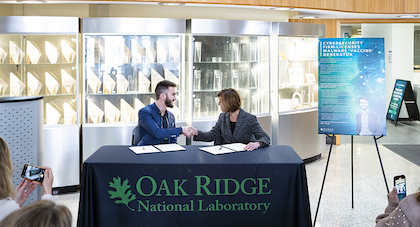
Jared Smith, former ORNL scientist and the inventor of the adversarial malware input generator (AMIGO), shakes hands with Susan Hubbard, ORNL deputy for science and technology, after signing a licensing deal with Smith’s company, Penguin Mustache.
Source: Carlos Jones/ORNL
Smith likens the process to vaccine development. “It’s as if we generated a million virus variants and a million vaccines to protect against them; we can collapse that into one vaccine and inoculate everyone. They’re protected against the threat, but also all the natural evolutions of the threat going forward.”
Luke Koch, who in 2019 worked on the AMIGO development team through the DoE Office of Science’s Science Undergraduate Laboratory Internship (SULI) program, is now a doctoral student at the Bredesen Center for Interdisciplinary Research and Graduate Education, a collaboration between ORNL and the University of Tennessee, as well as a graduate research assistant in ORNL’s Cybersecurity Research Group. With Smith’s direction, Koch wrote the binary instrumentation code used in AMIGO.
“Cybersecurity commercialization is important because our adversaries are always probing for weaknesses throughout the supply chain,” Koch said. “One single flaw is all it takes to invalidate a clever and expensive defense.”
Amid a growing public understanding of the power of AI, the team is eager to see AMIGO integrated into Evasive.ai and implemented by national security agencies to protect government assets and infrastructure.
“Bad actors are already using artificial intelligence to advance their attacks,” Bruce said. “As open AI tools improve, attempts to penetrate security systems will increase in volume and sophistication.”
Additionally, long-term use of the Evasive.ai platform could inform a more complete understanding of the mechanisms that contribute to adversarial samples. This insight will make the next generation of machine learning defenses more robust.