
The crude oil spill from the subsea oil pipeline in Rayong province in Thailand in early 2022 was another major incident that devastated the marine ecosystem while continuing to affect the economy and tourism. Although various agencies have tried to remove oil residue from the ocean surface, and along the coast, there is still some residual pollution that will adversely affect the environment and marine life for a very long time.
One of the solutions for eliminating residual pollutants is oil-eating microbes.
Pollutant Degradation
As an environmental microbiologist, Pinyakong has been interested in contamination from oil and petroleum and has worked on environmental pollutants degradation. And in the past, there have been frequent oil spills at sea, some of which made the news and some didn’t.

“Usually, managing oil spills starts with the use of physical methods, such as using oil booms, then removing oil from the area, or spraying oil dispersants. Either way, a biodegradation process follows. However, the limitation of the biodegradation process is the slow pace and unpredictability. So, if we can accelerate the biodegradation process after the physical treatment, it should help to restore the environment, while reducing the impact on the organisms in the ecosystem.”
When the key problem lies in the biodegradation process, an expert in microbials, such as Pinyakong does not fail to think of “oil-eating microbes” that can biodegrade the residual oil pollutants in the environment as well as toxic substances in other types of oil.
To accelerate the biodegradation process, effective oil-eating microbes must be used in sufficient quantities. Pinyakong said microorganisms are already present in the environment, but may not be sufficient or effective. To increase the number of microbes, they must first be developed into bioproducts or products so they perform well in certain environments, and have long shelf life while retaining the same efficiency and quantity.
“Thailand is considered to have high biodiversity both in the sea and other areas. It is a good source of microorganisms that have the properties to degrade various types of pollutants and petroleum. Therefore, our work started with the search for effective microorganisms from many different sources until we can develop them into products.”
One Available
Pinyakong said in foreign countries, one requirement for oil transport is that there must always be a product to remove oil residue on board ready for use in the event of an oil spill. However, in Thailand, there is only one such product on the market as compared to other countries with a wide range of options. Also, a product manufactured abroad may not be most effective for Thailand’s unique environment.
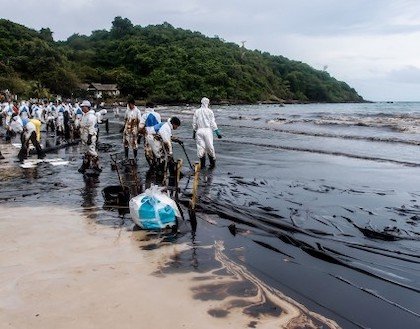
A bioproduct is in development to clean up oil spills in the ocean.
Source: Chula
“The microbes we use are microorganisms selected from nature using a specialized selection process. The food source for these microbes are pollutants that can be harmful to humans and animals, but the microbes have enzymes that can digest those pollutants and use them as energy sources without being poisoned. This also includes other microorganisms that help protect microbes, such as microorganisms that make biofilms or microbes that make bio-surfactants allowing easier access to the pollutants.”
In most cases, these microorganisms can be found at sources that have previously been contaminated with those pollutants or in areas with high biodiversity, such as sediments from the sea, sediments from mangroves forests, as well as water or soil contaminated with petroleum hydrocarbons.
“Our job is to find the right conditions, design and feed the microbes, find ways to separate the microbes from nature and multiply them and study the effectiveness and mechanisms of degradation using a variety of biomolecular and physiological methods to ensure the isolated microorganisms are not pathogenic, and safe for users and that when microorganisms decompose pollutants, they do not lead to residues of pollutants or cause more severe pollutants,” Pinyakong said. “This means we have to study from the upstream, test the effectiveness and environmental impacts until the final products are derived.”
After obtaining the toxins-digesting microbes, also known simply as oil-eating microbes, the next step is to develop a product that is ready to use.
Microorganisms are prepared as suspension form in the selected substance, which will allow a longer shelf life and convenient use, such as in blasting the contaminated sand or soil.
The isolated microorganisms are mixed with agricultural waste materials and cell protectors and form into pellets. They can be used to treat contaminated soil or sand, while also aerating the soil and improving the effectiveness of the biodegradation process.
Contaminated Water
This product is suitable for contaminated water. The microbial immobilization will absorb and contain the oil that is the microbes’ food enabling the microbes to degrade the oil more effectively. This type of product is widely sold abroad.
Although such bioproducts allow for complete degradation and are environmentally friendly, there are still limitations to their use.
“If there is a large amount of oil spill, the management process cannot start with biological methods because they require a long period of time and may not tolerate high toxicity, but these products can be a supplement to other methods to minimize environmental impact.”
Pinyakong said there are only a limited number of oil-spill cleaning products for the sea available in the market, and they are at a fairly high price.
“Price reduction is also one of the challenges in the research. Our cost of production mainly comes from the microbes feed, and the research team has experimented with using industrial and agricultural waste materials with carbon that is the source of energy for oil-eating microorganisms, to reduce costs.”
Currently, what the research team has produced is still just laboratory prototype products, but some have already expanded the scale of production to the factory level. However, the production capacity is not enough for real-world use in large-scale oil spills. Some products have also been used in field tests, including treatment of wastewater from factories, biodegradation processes for refineries and gas stations of research sponsor companies.
“Our idea is to develop a variety of products to create effective microbes, test production scalability, and preliminary field test for oil dispersant and degradation capacity,” Pinyakong said. “If there are people who are interested in expanding production for real-world use, we can transfer the technology to enable produce on a larger scale.”