
When it comes to cyberattacks in the manufacturing sector, the same thing holds true from last year, money remains an threat actor’s main focus behind most attacks, according to the 2024 Data Breach Investigations Report (DBIR) from Verizon Business.
Overall, this year’s DBIR analyzed a record-high 30,458 security incidents and 10,626 confirmed breaches in 2023, which was a two-fold increase over 2022. Of those incidents, there were 2,305 incidents, with 849 with confirmed data disclosures in the manufacturing sector.
Manufacturing over the past year dealt with a new type of issue and that was misdelivery, or sending information to the wrong person, according to the report. Nearly half (48 percent) of error-related breaches in manufacturing are due to misdelivery, the report found.
Installation of malware after hacking via the use of stolen credentials is somewhat commonplace across all industries. Sending things to the incorrect recipient does appear to be widespread regardless of vertical or industry sector. In addition, loss (20 percent) and misconfiguration (18 percent) round out the top three areas for error-related breaches in the manufacturing sector.

In terms of threat actors, the report found 73 percent were external, but 27 percent were internal in the manufacturing sector. While the internal number is in the minority, it does appear a manufacturer should ensure there are methods to detect internal attacks.
In terms of types of breaches, system intrusion continues to hold on to the top spot in manufacturing, most likely because of the combination of hacking via use of stolen credentials (present in 25 percent of manufacturing breaches) to gain access to the environment and then the application of ransomware (involved in 35 percent of breaches in this vertical).
Social engineering remains steady in regard to breaches in this vertical due to action varieties such as phishing (55 percent) and pretexting (42 percent), which is the use of a fabricated story, or pretext, to gain a victim’s trust and trick or manipulate them into sharing sensitive information, downloading malware, or sending money to criminals.
Overall in the DBIR, exploiting vulnerabilities as an initial point of entry almost tripled from the previous year, accounting for 14 percent of all breaches. This spike primarily came from the increasing frequency of attacks targeting vulnerabilities on unpatched systems and devices (Zero Day vulnerabilities) by ransomware actors. The MOVEit software breach was one of the largest drivers of these cyberattacks.
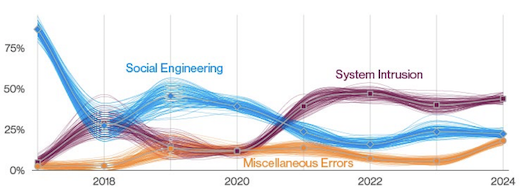
Top patterns over time in manufacturing industry breaches.Source: 2024 Data Breach Investigations Report
Last year, 15 percent of breaches involved a third party, including data custodians, third-party software vulnerabilities, and other direct or indirect supply chain issues, according to the report. This metric shows a 68 percent increase from the previous period in the 2023 DBIR.
In addition, most breaches (68 percent), whether they include a third party or not, involve a non-malicious human element, which refers to a person making an error or falling prey to a social engineering attack. This percentage is about the same as last year.
One potential offsetting force is the improvement of reporting practices: 20 percent of users identified and reported phishing in simulation engagements, and 11 percent of users who clicked the email also reported it.
Click here to view the entire DBIR.