
Computer vision-based technologies are advancing rapidly owing to developments in integrating deep learning. In particular, human motion capture is a highly active research area driving advances for example in robotics, computer generated animation and sports science, said researchers at Tokyo Institute of Technology (Tokyo Tech) and Carnegie Mellon University.
Now, a team of researchers led by Hideki Koike at Tokyo Tech created a new motion capture system that consists of a single ultra-wide fisheye camera mounted on the user’s chest. Their design not only overcomes the space constraints of existing systems but is also cost-effective.
Named MonoEye, the system can capture the user’s body motion as well as the user’s perspective, or viewport.

“Our ultra-wide fisheye lens has a 280-degree field-of-view and it can capture the user’s limbs, face, and the surrounding environment,” the researchers said in a report.
To achieve robust multimodal motion capture, the system has been designed with three deep neural networks capable of estimating 3D body pose, head pose and camera pose in real-time.
Already, the researchers have trained these neural networks with an extensive synthetic dataset consisting of 680,000 renderings of people with a range of body shapes, clothing, actions, background and lighting conditions, as well as 16,000 frames of photo-realistic images.
Some challenges remain, however, due to the inevitable domain gap between synthetic and real-world datasets. The researchers plan to keep expanding their dataset with more photo-realistic images to help minimize this gap and improve accuracy.
The researchers envision the chest-mounted camera could go on to be transformed into an everyday accessory such as a tie clip, brooch or sports gear in future.
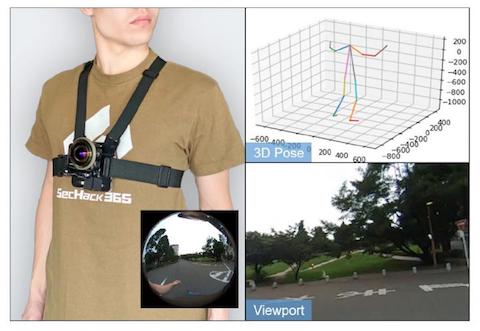
MonoEye is based on a single ultra-wide fisheye camera worn on the user’s chest, enabling activity capture in everyday life.
Source: ACM, UIST