
Along those lines, 74 percent of organizations attribute business-impacting cyberattacks to vulnerabilities in technology put in place during the pandemic, a new study found.
The data is from a report entitled, “Beyond Boundaries: The Future of Cybersecurity in the New World of Work,” a study Tenable Inc. commissioned of more than 1,300 security leaders, business executives and remote employees conducted by Forrester Consulting.
From cloud services and applications to personal devices and remote access tools, the corporate attack surface exploded in record time. Difficulty managing the plethora of technologies has made enterprises more vulnerable and propelled cyberattacks.
Moreover, 80 percent of security and business leaders said their organizations are more exposed to risk as a result of remote work.

This exposure was largely driven by three factors:
- Enabling a workforce without boundaries: Over half of remote workers access customer data using a personal device, yet 71 percent of security leaders lack high or complete visibility into remote employee home networks. This gap is well understood by bad actors, as reflected in the fact 67 percent percent of business-impacting cyberattacks targeted remote employees.
- Expanding the software supply chain: 65 percent of security and business leaders attribute recent cyberattacks to a third-party software compromise; 61 percent report increased risk due to their expanded software supply chain.
- Migrating to the cloud: 80 percent of security and business leaders believe moving business-critical functions to the cloud elevated their risk; 62 percent of organizations suffered business-impacting attacks involving cloud assets.
“Remote and hybrid work strategies are here to stay and so will the risks they introduce unless organizations get a handle on what their new attack surface looks like,” said Amit Yoran, chief executive of Tenable. “This study reveals two paths forward — one riddled with unmanaged risk and unrelenting cyberattacks and another that accelerates business productivity and operations in a secure way. CISOs and CEOs have the opportunity and responsibility to securely harness the power of technology and manage cyber risk for the new world of work.”
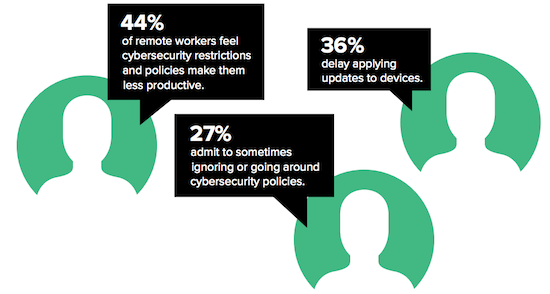
Reasons for not using or enforcing security for remote workers.Source: Tenable and Forrester
Hybrid work models and a digital-first economy have brought cybersecurity front and center as a critical investment that can make or break short- and long-term business strategies.
To address this demand, two thirds or more of security leaders plan to increase their cybersecurity investments over the next 12 to 24 months, with roughly three-quarters planning to spend more on vulnerability management and cloud security. Understanding the profound risks created by talent shortages, 64 percent of leaders lacking staff plan to invest within by increasing their teams’ headcount over the next 12 months.
Given that attacks target remote workers, security teams can no longer rely on strategies rooted in a “trust but verify” approach. That is why adopting a zero trust model, where no one is trusted and everything must be validated, becomes key as it requires continuous evaluation of users and their permissions. In order to secure the business – in an environment where the perimeter has disappeared, and the attack surface continues to expand – users must:
- Expand management of risk beyond software flaws and device compliance
Invest in adaptive user risk profiles that dynamically change - Perimeter-based methods no longer apply; it’s time for a zero trust model
- Start the zero trust journey with a few simple steps: Understand what key assets you are trying to protect, and make a list of all the large enterprise risks that could jeopardize critical assets
Click here to register to download the entire report.