
By Gregory Hale
Two contractors had no inkling a fire broke out in a confined space when two other contractors working in a different area of the space dropped a heat gun fell into a bucket of flammable resin.
That fire killed the two contractors working at the Evergreen Packaging facility in Canton North Carolina on September 21, 2020, according to a Chemical Safety Board (CSB) safety video explaining the tragedy, entitled “Simultaneous Tragedy: Fire at Evergreen Packaging.”
The paper mill was undergoing a planned shutdown, and associated maintenance and capital project work was ongoing throughout the facility, according to the CSB report.

The pulp bleaching process is corrosive by design, and the upflow and downflow towers were constructed of corrosion-resistant materials. However, due to the corrosive nature of the process, the upflow and downflow towers required periodic maintenance to their inside surfaces.
The upflow tower was constructed of fiber- reinforced plastic (FRP), and Blastco’s repair work in the upflow tower required the application of flammable epoxy vinyl ester resin and sheets of fiberglass to the inside walls of the vessel. However, cool ambient temperatures in the area on the night of the incident caused the resin to harden slower than the Blastco workers anticipated, resulting in the newly applied resin and fiberglass sliding down the walls of the vessel.
The Blastco workers attempted several means of addressing the issue but were ultimately unsuccessful. Two Blastco workers resorted to using a portable, electric heat gun to warm the resin, enabling it to harden faster. The Blastco crew did not warn or communicate to Evergreen or Rimcor its use of the heat gun, which was an ignition source in the presence of the flammable resin.
At 5:15 a.m., a fire started inside the upflow tower when the heat gun fell into a five-gallon bucket containing flammable resin. The Blastco workers inside the upflow tower successfully escaped the fire and evacuated the vessel. However, smoke and flames quickly spread to the connected downflow tower, fatally injuring two Rimcor workers, Brett Burgueno, Curtis Butler.

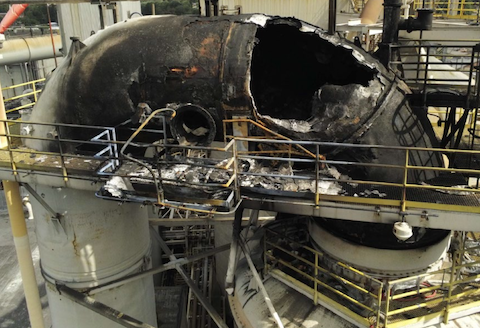
Burned out connector tube that led to the downflow tower where two contractors perished in a preventable safety incident.
Source: CSB
The CSB’s safety video includes an animation of the events leading up to the incident.
In the video, the CSB identified four safety issues that led to the incident at Evergreen Packaging:
Hot work safety: The electric heat gun used to warm the flammable resin could achieve temperatures in excess of the resin’s flash point and auto-ignition temperatures. The electric heat gun came into direct physical contact with the flammable resin when it fell into the resin bucket. Blastco did not recognize the ignition hazard presented by the use of the heat gun, did not inform Evergreen or Rimcor of the heat gun’s use, and did not take adequate action to prevent the introduction of ignition sources into a confined space containing flammable liquids. In addition, while Evergreen’s internal policies defined hot work as “any activity that could serve as a source of ignition,” Evergreen’s contractor orientation materials limited the hot work definition to only “burning, cutting, brazing or welding.”
“Hotwork safety is a major safety issue that we identified during our investigation,” said Drew Sahli, CSB lead investigator. “We found the Blastco workers did not recognized the heat gun as an ignition source. Asa result proper hot work permitting and effective safety precautions were not implemented.”
Pre-job planning: Cool ambient temperatures on the night of the incident caused poor performance of the resin Blastco was using to repair the inside surface of the upflow tower. Blastco workers unsuccessfully attempted several means of addressing the problem prior to resorting to warming the resin with a heat gun. Drum heaters, which might have prevented this incident by warming the resin in a drum outside the upflow tower, were not identified in pre-job planning efforts, and Blastco workers were unable to locate them on Blastco’s job trailer. The work also was not performed during the day when temperatures were warmer, which may have eliminated the need to warm the resin.
“Hotwork should be avoided if a safer alternative is available,” Sahli said. “Effective pre-job planning could have prevented this incident. Blastco could have used a troubleshooting guide to address the cold weather or it may have been able to delay the work until ambient temperatures were warmer.”
Confined space safety: Evergreen, Blastco and Rimcor treated the upflow and downflow towers as separate and independent confined spaces, even though the towers were connected by a crossover pipe. Blastco failed to terminate the confined space entry when a new hazard, the heat gun, was introduced into the space. There was no coordination between the two contract crews, and no evaluation was made as to whether the simultaneous operations posed a hazard to each other. In addition, Blastco did not effectively evaluate the flammable material hazards presented by its work in the upflow tower, and Evergreen did not ensure its emergency response team was on standby outside the upflow tower while flammable materials were used inside the confined space.
Combustible materials of vessel construction: The five-gallon bucket in which the fire initiated in the upflow tower did not contain enough fuel to sustain the size and duration the fire achieved during the incident. Evidence shows the upflow tower itself, constructed of combustible FRP, caught fire. This contributed to the spread of smoke and flames to the downflow tower, where the two Rimcor employees were fatally injured.
As a result of its investigation, the agency made recommendations to Evergreen Packaging, the Occupation Safety and Health Administration (OSHA), and Blastco to address those safety issues.
The incident at Evergreen Packaging was entirely preventable,” said Katherine Lemos, CSB chairperson and chief executive. “Worker safety, employees and contractors, is a critical responsibility of the facility owners and operators whether the facility is operating normally or in maintenance and upgrades.”
Click here to view the video.