
In September, an FIBC containing blasting operations material was lifted out of a cargo basket by the platform crane using its pre-manufactured straps. Upon moving the load out and away from the cargo basket, one of the straps failed, transferring the weight of the load to the other strap, which subsequently failed due to exceeding its load capacity.
The FIBC dropped 5 feet onto the deck grating below, according to a report from the Bureau of Safety and Environmental Enforcement (BSEE).
Also in September, while a forklift was lifting an FIBC containing lost circulation material for drilling operations, tension on the FIBC straps caused two of the four straps to part. The FIBC was not dropped from an elevation as the load never became suspended. However, the accelerated whiplash due to the straps failing resulted in the FIBC spilling a gallon of its dry chemical contents onto the deck. Personnel promptly cleaned up the material in the area.
In October, in preparation to trip and lay-out drill pipe, drill floor personnel communicated the need for additional thread protectors.

The crane crew rigged up an FIBC containing multiple thread protectors to be transported to the nearby pipe rack area. The crane operator swung the load slightly over the pipe rack when the designated signal person observed the straps breaking and the FIBC ripping apart. Two thread protectors fell out of the FIBC onto the pipe rack six feet below. No crew members were in the drop zone at the time of the incident.
The primary contributing factor associated with these failures is the prolonged exposure of the FIBCs to inclement weather and other natural elements, resulting in their rapid degradation and subsequent failures.
A recurring conclusion from the incident investigations suggested the FIBCs were saturated with water and had debris on their outer linings due to Hurricane Ida in early September 2021. Additionally, polypropylene is the primary component used to manufacture FIBCs, which is known to deteriorate over time when exposed to ultraviolet light. The lack of adequate storage potentially compromised the original integrity of the FIBCs.
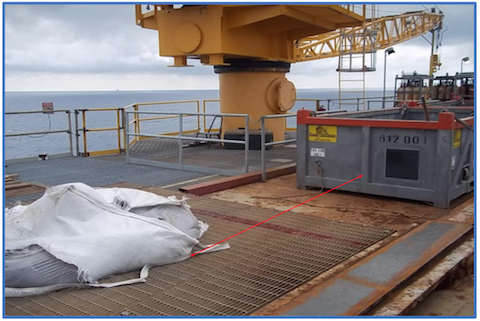
FIBC Load travel Path from the Cargo Basket to the Drop Zone 17 Feet Away.Source: BSEE
Along those lines, BSEE recommends operators and contractors consider the following:
- Confirm the weight limitation of the FIBC before lifting the load.
- Establish a Quality Assurance/Quality Control program to ensure FIBCs are adequately stored before transportation to minimize any adverse effects from weather or ultraviolet light.
- Ensure FIBCs are kept out of the cold weather (< 32 deg F) when not in use. Under a heavy load or unevenly distributed load in below freezing temperatures, the straps can become brittle, which could lead to a loss of the load when lifted.
- Create a mechanism for tracking the transportation process of FIBCs from the shipyard to the facility to confirm they are maintained in a safe condition.
- Generate an inspection protocol and remove the FIBC from service before lifting if any degradation is observed in the pre-manufactured straps.
- Emphasize during safety meetings before the job the force applied to each FIBC strap is equally distributed to prevent overloading.
- Update applicable policies and procedures to include alternative lifting methods, such as transferring FIBC material via pre-slung baskets instead of utilizing the pre-manufactured FIBC straps.
- Ensure a 4-point lifting technique is applied to the FIBC straps to maintain the integrity of the load as designed in place of utilizing a single-point lift.
- Confirm the contents in the FIBC are compatible with all FIBC components before offloading to the facility. FIBCs may not be the approved storage device for some materials, as certain products may have an adverse effect on their overall integrity.