
One promising solution is quantum cryptography – a quantum technology that uses single photons to establish encryption keys. To that end, a team from the Faculty of Physics at the University of Warsaw developed and tested in urban infrastructure a novel system for quantum key distribution (QKD).
This system employs high-dimensional encoding. The proposed setup is simpler to build and scale than existing solutions, while based on a phenomenon known to physicists for nearly two centuries: The Talbot effect.
“Our research focuses on quantum key distribution – a technology that uses single photons to establish a secure cryptographic key between two parties,” said Dr. Michał Karpiński, head of the Quantum Photonics Laboratory at the Faculty of Physics, University of Warsaw. “Traditionally, QKD employs so-called qubits – the simplest units of quantum information. While this method is already well tested, it does not always meet the requirements of more demanding applications. That’s why researchers are now working on multidimensional encoding. Instead of qubits, which yield one of two measurement outcomes, we use more complex quantum states that can take on multiple values.”
Photon Focus
At the Quantum Photonics Laboratory, researchers focus on time-bin superpositions of photons – situations where a photon is neither “earlier” nor “later” but exists in a combination of these states. The detection time of a single photon in such a superposition yields a random outcome. Such a state encodes information using the relation between earlier and later pulses, i.e., in the phase of the light wave.

“Until now, efficient detection of superpositions of two pulses – earlier and later – was possible. We went a step further: We are interested in cases with more time bins, ranging from two to four or even more,” Karpiński said.
The researchers drew inspiration from the Talbot effect – a classical optics phenomenon first described in 1836 by Henry Fox Talbot, a pioneer of photography.
“When light passes through a diffraction grating, its image repeats itself at regular intervals – as if it ‘revives’ at a certain distance. Interestingly, the same effect occurs not only in space but also in time, provided that a regular train of light pulses propagates in a dispersive medium such as an optical fiber,” said Maciej Ogrodnik, a PhD student at the Faculty of Physics, UW.
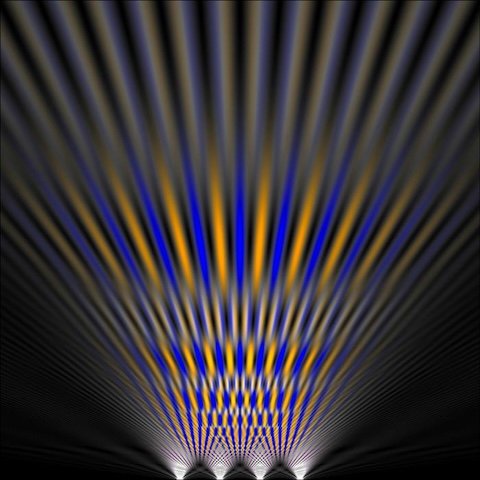
Detection of time-bin superpositions with the temporal Talbot carpet.
Source: Maciej Ogrodnik, University of Warsaw
“Thanks to the space-time analogy in optics, we can apply the Talbot effect to short light pulses, including single photons – thereby gaining new capabilities for analyzing and processing quantum states. In our case, a sequence of light pulses acts like a diffraction grating and can ‘self-reconstruct’ in time under dispersion after traveling some distance in an optical fiber. Moreover, the way pulses interfere depends on their phase, which allows us to detect different types of superpositions.”
4D QKD System
Along those lines, the UW research team developed an experimental four-dimensional QKD system.
“Importantly, the entire setup is built using commercially available components. The key trick is that the system requires only a single photon detector to register superpositions of many pulses – instead of a complex network of interferometers,” said Adam Widomski, a PhD student at the Faculty of Physics, UW.
“This significantly reduces the complexity and cost of the measurement system. Moreover, our method does not require separate, often time-consuming and challenging calibration of the receiver.”
“Traditionally, to detect phase differences between pulses, we use a multi-interferometer setup – something like a tree, where pulses are split and delayed. Unfortunately, such systems are inefficient, since some measurement outcomes are useless. The efficiency drops with the number of pulses, and the receiver requires precise calibration and stabilization,” Ogrodnik said.
“The advantage of our method is its high efficiency, as all photon detection events are useful. The drawback is relatively high measurement error rates. However, these do not prevent QKD, as we showed in collaboration with researchers working on the theory of quantum cryptography. Furthermore, we do not need to rebuild the setup for different dimensions of superpositions – we can detect 2D and 4D superpositions without changing hardware or stabilizing the receiver. This is a huge advantage compared to earlier methods,” Widomski said.
The researchers tested their solution in laboratory optical fibers and in the fiber infrastructure of the University of Warsaw over distances of several kilometers.
New Method Passes Test
“Thanks to the new method using the temporal Talbot effect, we successfully demonstrated QKD with two- and four-dimensional encoding, using the same transmitter and receiver. Despite errors inherent to the simple experimental approach, our results confirm the higher information efficiency of the system resulting from high-dimensional encoding,” Widomski said.
The main advantage of QKD is its theoretical security, which can end up proven under basic assumptions. For this reason, from the start of the project, UW researchers collaborated with groups in Italy and Germany specializing in QKD security proofs.
“A closer analysis shows that the standard description of many QKD protocols is incomplete, which attackers could exploit. Unfortunately, our method shares this vulnerability. We took part in efforts to solve this issue. Our collaborators found that a certain modification of the receiver allows for collecting more data, thus eliminating the vulnerability,” Ogrodnik said.