
But when time is of the essence, the ability to detect biothreats often relies on expertise and equipment that’s difficult to transport and takes time to carry out. But that may soon change.
Through a collaborative agreement with the U.S. Department of Homeland Security worth as much as $2.5 million over five years, researchers at Iowa State University hope to find a solution where they create a portable sensor to detect biothreats.
“Up to now we’ve been looking at detecting infectious viruses in people who are infected,” Nilsen-Hamilton said. “This is an opportunity to develop a means of detecting viruses and other biothreats in the air. In other words, we’d be able to quickly identify when there is a biothreat in the surrounding environment and protect people from exposure.”

The team proposes to create a device roughly the size of a shoebox that can sample the air for a range of biothreats, including Ebola virus, SARS-CoV-2 and various toxins.
The technology would include a microfluidic collection device that gathers air samples and a suite of sensors to detect and identify biothreats. The device will transfer particles extracted from air samples into a liquid stream to concentrate the particles. The stream passes through an aluminum oxide membrane that contains aptamers, or nucleic acids that behave similarly to antibodies in the human immune system. The biothreat particles bind to the aptamers, which sets off an electrical signal that the sensors detect.
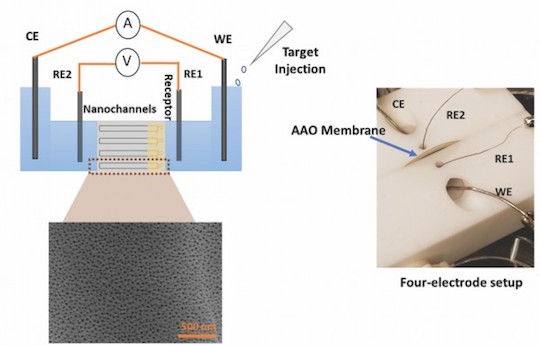
This diagram shows how the biothreat detection technology functions. Biothreat particles bind to aptamers coated on the aluminum oxide membrane. The particle/aptamer binding modifies the electrochemical conduction across the membrane registered by sensors, shown here comprised of four electrodes.
Source: Pranav Shrotriya
Researchers in Nilsen-Hamilton’s laboratory will select aptamers capable of binding to the proteins of the various biothreats included in the scope of the project. Her lab has isolated and characterized eight aptamers from millions of aptamer candidates selected for previous research projects, and she said one of the challenges for this project will be finding optimal aptamers for each threat.
Part of the challenge for the project comes from the wide range of biothreats the device aims to detect, said Todd Kingston, an assistant professor of mechanical engineering and research team member. The device must reliably capture and identify various particles that have dimensions ranging from a few nanometers to micrometers, a unit of measurement that’s a thousand times larger.
The difference between a micrometer and a nanometer might seem insignificant under most circumstances, but, at the microscopic level where the researchers work, that’s a lot of variability for one technology to handle. Kingston said the scientists are considering ways to capture a wide range of aerosolized biothreats.
The research team also includes Monica Lamm, an associate professor of chemical and biological engineering; Pranav Shrotriya, a professor of mechanical engineering; and Wendy Maury, a virologist at the University of Iowa. Shrotriya said the team intends to have a functional device by the conclusion of the collaborative agreement.
“We hope to have a working device that acts as a proof of concept at the end of five years,” Shrotriya said “We want to make sure the device can trap different size particles as well as sense them.”