
After considering more than a year’s worth of community feedback, NIST released a draft version of the Cybersecurity Framework (CSF) 2.0, a new version of a tool it first released in 2014.
The draft update, which NIST released for public comment, reflects changes in the cybersecurity landscape and makes it easier to put the CSF into practice — for all organizations.
NIST is accepting public comment on the draft framework until Nov. 4. NIST does not plan to release another draft.

A workshop planned for the sometime this fall will serve as another opportunity for the public to provide feedback and comments on the draft. The developers plan to publish the final version of CSF 2.0 early next year.
The CSF provides high-level guidance, including a common language and a systematic methodology for managing cybersecurity risk across sectors and aiding communication between technical and nontechnical staff. It includes activities that can be incorporated into cybersecurity programs and tailored to meet an organization’s particular needs.
In the decade since it first published, users downloaded the CSF more than two million times by users across more than 185 countries. It has also ended up translated into at least nine languages.
While responses to NIST’s February 2022 request for information about the CSF indicated the framework remains an effective tool for reducing cybersecurity risk, respondents also suggested an update could help users adjust to technological innovation as well as a rapidly evolving threat landscape.
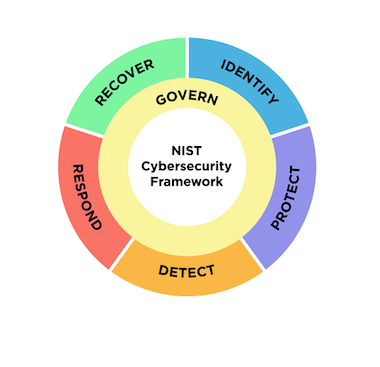
NIST added a sixth pillar to the five main pillars of a successful cybersecurity program – the “govern” function, which emphasizes cybersecurity is a major source of enterprise risk and a consideration for senior leadership.
Credit: N. Hanacek/NIST
Source: NIST
The CSF 2.0 draft reflects a number of major changes, including:
- The framework’s scope expanded from protecting critical infrastructure, such as hospitals and power plants, to providing cybersecurity for all organizations regardless of type or size.
- Until now, the CSF described the main pillars of a successful and holistic cybersecurity program using five main functions: Identify, protect, detect, respond and recover. To these, NIST now has added a sixth, the govern function, which covers how an organization can make and execute its own internal decisions to support its cybersecurity strategy. It emphasizes cybersecurity is a major source of enterprise risk, ranking alongside legal, financial and other risks as considerations for senior leadership.
- The draft provides improved and expanded guidance on implementing the CSF, especially for creating profiles, which tailor the CSF for particular situations. The cybersecurity community requested assistance in using it for specific economic sectors and use cases, where profiles can help. Importantly, the draft now includes implementation examples for each function’s subcategories to help organizations, especially smaller firms, to use the framework effectively.
A major goal of CSF 2.0 is to explain how organizations can leverage other technology frameworks, standards and guidelines, from NIST and elsewhere, to implement the CSF. Bolstering this last effort will be the launch of a CSF 2.0 reference tool, which NIST plans to release in a few weeks. This online resource will allow users to browse, search and export the CSF Core data in human-consumable and machine-readable formats.
Click here to view the Cybersecurity Framework 2.0.