
But when?
Before the hurricane hit, the Bureau of Safety and Environmental Enforcement (BSEE) activated its Hurricane Response Team as Ida made its way through the Gulf. The Hurricane Response Team monitored offshore oil and gas operators in the Gulf as they evacuated platforms and rigs in response to the storm.
Before the hurricane struck, personnel have been evacuated from at least 288 production platforms, which is 51.43 percent of the 560 manned platforms in the Gulf of Mexico. Production platforms the structures located offshore from which oil and gas are produced. Unlike drilling rigs, which typically move from location to location, production facilities remain in the same location throughout a project’s duration.

Personnel evacuated from 11 rigs (non-dynamically positioned), equivalent to 100 percent of the 11 rigs of this type currently operating in the Gulf. Rigs can include several types of offshore drilling facilities including jackup rigs, platform rigs, all submersibles and moored semisubmersibles.
In addition, 7 dynamically positioned (DP) rigs moved off location out of the storm’s projected path as a precaution. This number represents 46.6 percent of the 15 DP rigs currently operating in the Gulf. Dynamically positioned rigs maintain their location while conducting well operations by using thrusters and propellers. These rigs are not moored to the seafloor; therefore, they can move off location in a relatively short time frame. Personnel remain on-board and return to the location once the storm has passed.
As part of the evacuation process, personnel activate the applicable shut in procedure, which can frequently be accomplished from a remote location. This involves closing the sub-surface safety valves located below the surface of the ocean floor to prevent the release of oil or gas, effectively shutting in production from wells in the Gulf and protecting the marine and coastal environments. Shutting in oil and gas production is a standard procedure conducted by industry for safety and environmental reasons.
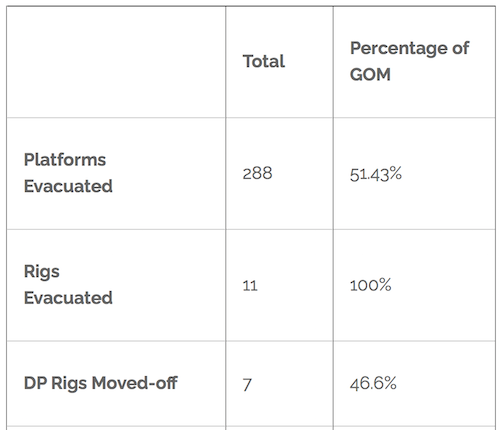
51.43 percent (288) of the 560 manned platforms in the Gulf of Mexico ended up evacuated. Personnel evacuated from 11 rigs. In addition, 7 dynamically positionedrigs moved off location out of harm’s way.
Source: BSEE
From operator reports, it was estimated 94.6 percent of the current oil production in the Gulf of Mexico had been shut in. BSEE estimates approximately 93.57 percent of the gas production in the Gulf of Mexico has been shut in. The production percentages are calculated using information submitted by offshore operators in daily reports. Shut-in production information included in these reports is based on the amount of oil and gas the operator expected to produce that day. The shut-in production figures therefore are estimates, which BSEE compares to historical production reports to ensure the estimates follow a logical pattern.
Because the storm has passed through the Gulf, facilities will now undergo inspection. Once all standard checks have been completed, production from undamaged facilities will be brought back online immediately. Facilities sustaining damage may take longer to bring back online.
In addition to the platforms out on the Gulf, six refineries in the New Orleans area – PBF, Phillips, Shell, Marathon and two from Valero — are shut down right now.
The location of Ida’s landfall could also affect pipelines that carry fuel from the Gulf Coast to the East Coast markets. The shuttered six refineries produce 1.7 million barrels per day of refinery capacity, representing 9 percent of the nations total, according to a CNN report.
Three refineries in the region — Exxon, Placid and Kratz Springs — are in the Baton Rouge area and were operating at a reduced capacity. Those three refineries produce 700,000 barrels per day.