
A night shift production operator working for Wood Group Production Services Network went missing from the Renaissance Offshore, LLC Eugene Island (EI)-331 “B” production platform while performing assigned work as part of routine production operations May 29, 2019 , according to a report released Thursday from a Bureau of Safety and Environmental Enforcement (BSEE) panel of BSEE subject matter experts, engineers, inspectors, and investigators.
The production operator, who was never found, was performing assigned monthly casing pressure checks when a grating failure occurred.
Less than 24 hours prior to the incident, a single section of severely corroded and deteriorated grating, (i.e. walking and working surface hazard) was identified on the north side of the wellbay by the Renaissance area supervisor / Ultimate Work Authority (UWA). The UWA notified other supervisory personnel on the facility of the hazardous grating section.
Danger Marking Tape
A strand of red “DANGER” marking tape, indicating immediate or foreseeable life-threatening hazard, was then affixed directly to the hazardous grating section and another strand was affixed and suspended from a nearby metal post to a process pipe, at the north perimeter of the wellbay. A work order titled “Grating at well bay not on H-beam” was created and assigned the top priority classification of “urgent.”

No additional actions were taken by supervisory personnel to warn or otherwise notify the remaining personnel on the facility of the identified and uncorrected life- threatening hazard, nor were any steps taken to isolate and prevent personnel from physically accessing the hazardous grating section in the danger area. Day shift activities continued unabated and into the night shift.
At the time of the incident, the facility was shut-in and not producing due to compressor maintenance and various construction tasks, which were assigned and initiated during the day shift. In preparation for a “pressing” construction task requiring hot-work above the wellbay, the entire wellbay perimeter was then marked with the same red “DANGER” marking tape. At the conclusion of the day shift, the red danger marking tape surrounding the wellbay perimeter and marking the walking and working surface hazard remained in place.
The mid shift PO and Victim both worked inside and around the wellbay as a requisite to perform assigned monthly casing pressure checks. The Victim was performing the assigned monthly casing pressure checks when the incident occurred. Additionally, the facility had been scheduled to come back online the following day.
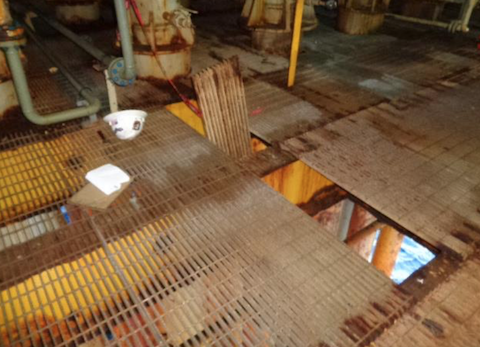
A production operator went missing while he was performing assigned monthly casing pressure checks when a grating failure occurred.Source: BSEE
According to the Renaissance Safety Check-In Procedure, the victim was required to check-in with the offsite Contact Safety Officer (CSO), via phone or email, at specified two-hour intervals (2400, 0200, and 0400) throughout the night shift. Pursuant to the procedure, the offsite CSO was required to immediately initiate a Search and Rescue (SAR) effort in the event a required check-in did not occur within 15 minutes of a specified interval. The victim only completed the 2400 check-in, via email, at the start of the night shift.
At approximately 0600, a facility wide search was initiated after the Victim did not report or respond and after some of the Victim’s personal protective equipment and task specific equipment items were discovered adjacent to an open hole, (located approximately 45’ above the waters surface). The open hole was created when the uncorrected and uncontrolled hazardous grating section, identified in the urgent work order, was displaced.
Search Concludes
While a search ended up conducted over a period of days, by June 3 Renaissance concluded its search activities with the victim never located, nor recovered.
In its report BSEE listed probable causes into the incident:
- Renaissance failed to maintain all of its walking and working surfaces on the facility in a safe condition
- Supervisors did not fulfill their respective responsibilities within the relevant, established Safe Work Practices (SWPs) when they failed to promptly correct or prevent employees from accessing the uncorrected and uncontrolled walking and working surface hazard area
- Renaissance and its contractors failed to follow the agreed upon terms and conditions within their respective Safety and Environmental
- Management Systems (SEMS) bridging arrangements
- Supervisors did not fulfill their respective responsibilities within the relevant, established SWPs when they failed to stop work and warn all personnel of the uncorrected and uncontrolled walking and working surface hazard
- Supervisors did not fulfill their respective responsibilities within the relevant, established SWPs when authorizing task-work within and around, the uncorrected and uncontrolled, walking and working surface hazard
In addition, BSEE listed some possible causes into the incident:
- Striking the hazardous grating section with a sledgehammer
- Reduced effectiveness of hazard communication markings
- Reduced effectiveness of hazard identification and communications to the work force
- Non-conformance with the Safety Check-In Procedure
The BSEE Panel made recommendations identified as a result of the investigative findings detailed within this report:
The BSEE Panel made recommendations identified as a result of the investigative findings detailed within this report:
- Operators should ensure all identified hazards are communicated to personnel in a timely and meaningful way and that findings receive appropriate consideration and corrective actions
- Operators and contractors should abide by the agreed upon terms of their respective SEMS bridging arrangements
- Supervisory personnel should be trained, skilled, and knowledgeable in their assigned duties and responsibilities and take an active role in task planning, hazard analysis, and supervision
- Training, guidance, and SWPs should be consistent and clear to reduce the risk of a misunderstanding
- Communication of hazards should be sufficient to prevent personnel from inadvertent hazard exposure
- Hazard analyses and work permits should be continually assessed and updated to maintain effectiveness within the dynamic working environment
- Emergency response plans and strategies should be appropriately and effectively managed
Click here for the full BSEE report.