
A new portable technology can now be used to help identify individuals in challenging outdoor conditions.
This advanced optical array developed at the Department of Energy’s Oak Ridge National Laboratory was just licensed by IDEMIA Identity & Security USA.
The system is designed to capture useable images of subjects inside moving vehicles, using an array of camera lenses sensitive to light intensity and direction. Resulting photos are enhanced with machine learning, resulting in high-quality composite images. The technology overcomes effects such as low contrast, distance and glare typical when photographing subjects through windshields.This technology, as applied by IDEMIA, has the potential to expedite vehicles at critical checkpoints.
“The technique takes advantage of light field imaging techniques and a computational neural network to address challenges in identity verification, including motion blur, poor lighting conditions, head pose and surface reflection,” said project lead and co-inventor Hector Santos-Villalobos.

The technology could be used for long-range identity verification, as well as in vehicle recognition, vehicle navigation systems and traffic monitoring systems.
“We are pleased to be working with Oak Ridge National Laboratory with the intent to develop high-performance imaging technology that will drive innovation for frictionless vehicle checkpoint crossing,” said Donnie Scott, senior vice president, public security for North America at IDEMIA. “Creating a more frictionless process of monitoring vehicles as they pass through checkpoints while ensuring safety is a commitment that IDEMIA asserts is a priority.”
“I am confident that exploring this solution will result in important progress for our nation’s border security,” he said.
IDEMIA provides secured platforms and environments that enable people to perform their daily activities that require identification in the physical as well as digital space.
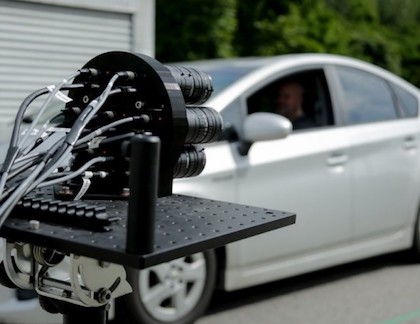
Scientists demonstrated an early prototype of the optical array developed by Oak Ridge National Laboratory.
Source: Butch Newton, Oak Ridge National Laboratory