
Microsoft ended support for Windows XP when it reached its end-of-support date in 2014 and for Windows Server 2003 in 2015. Therefore, any vulnerabilities discovered since then remain unaddressed (with the exception of a patch in 2017 for the WannaCry attack). Although the leaked Windows XP source code might have circulated privately even earlier, the recent leak makes it broadly available for the first time. As a result, more hackers can easily identify potential vulnerabilities for which there are no software fixes.
That issue is a constant problem, especially in the manufacturing automation sector where plenty of organizations are still running Windows XP and Windows Server 2003.
Along those lines, Unit 42 researchers Jun Du, Derick Liang and Aveek Das reviewed the data challenges this brings up for organizations and will provide information about the best solutions to address the problem. They will also provide a list of detailed recommendations to mitigate the impact of this specific incident around the source code leak for Windows XP and Windows Server 2003.
Easier Said than Done
At a glance, this may seem like an easy problem to solve – update the operating system and run up-to-date, supported software on all systems. However, there are administrative and operational challenges that complicate the migration process.

Most organizations manage information technology (IT) and operational technology (OT) as separate teams with separate processes using separate tools, the researchers said. While IT focuses on the organization’s IT assets – such as computers, network equipment and printers – OT focuses on non-IT assets, such as medical devices, factory floor equipment and security cameras. For example, in the healthcare industry, biomedical engineers understand and maintain the medical devices. However, they don’t typically maintain the underlying operating systems that power the devices, nor do they manage the global security policies that govern these systems. The gaps between OT and IT security practices and operations result in ongoing use of devices that continue to run end of life operating systems. As a consequence, these devices are often prone to attacks that IT has been protected from for over a decade.
Updating the software in IoT devices is not as straightforward as updating a normal laptop or desktop, as certain functionalities of the IoT device only work with a specific Windows version. In healthcare specifically, biomedical engineers need to ensure existing software running on the new versions of Windows complies with FDA regulations and does not introduce any new vulnerabilities for the medical devices.
The Windows XP and Windows Server 2003 operating systems, in addition to no longer being supported by Microsoft, come with a host of vulnerabilities and security threats. Most common vulnerabilities can allow an attacker to run remote code, cause memory overflow issues or restrict usage of devices by performing a Denial of Service (DoS) attack.
Network Segmentation
The simplest IoT risk remediation practice is network segmentation. However, due to a large number of medical IoT devices running end of life operating systems, even subnetworks with proper network segmentation are at risk, Unit 42 researchers said. Having a vulnerable Windows XP or Windows Server 2003 device increases the attack surface. Moreover, an attacker can move laterally across a network to infect other devices.
Even with all the issues present today, Windows XP and other end of life Windows versions are still popular in older IoT and OT devices. Many of these devices are mission-critical and yet difficult to manage. It is often a daunting task to upgrade them without the risk of introducing a network-wide interruption to business operations. As a result, most businesses choose not to do so. As a result, an endpoint security solution is unlikely to sufficiently protect against vulnerabilities.
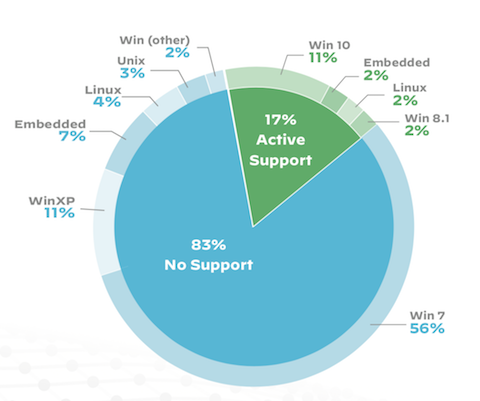
Operating system usage on imaging devices.Source: Unit 42
As a consequence of these obstacles, IoT and OT devices can essentially be rendered un-upgradable, and with viable endpoint solutions often out of the question, how can organizations stay protected from the threats that rely on exploits collected over hundreds of existing vulnerabilities? The answer lies in network behavior monitoring and network traffic analytics powered by artificial intelligence and machine learning, the researchers said.
Traditionally, threat detection relies on deploying thousands of rules that look for predetermined byte patterns in the network payload. But it is not capable of detecting Zero Day attacks or network behavior changes as a result of the attacks. To discover changes in network behavior and detect attacks like this, A machine learning based solution has been proven to be effective. Machine learning algorithms can end up used to inspect the network traffic, discover and learn the repeatable behavior patterns carried in the traffic and then build that into mathematical models that serve as the network behavior baseline for an IoT device. Corresponding detection algorithms can then be put in place using these models to predict attacks when a deviation from the device’s network behavior baseline is observed.
Security Policies
To truly secure IoT and OT devices, a solution can’t stop at monitoring and detecting behavioral anomalies or attempting to associate them with certain attack scenarios. The network behavior needs to be controlled with a good set of security policies, which can be effective at stopping the behavior before the attack is set in motion. This can be best achieved by integrating IoT monitoring with a next-generation firewall. When the user is allowed to create a policy based on the device identity and the operating system used, bad behaviors can be easily blocked and filtered out. Artificial intelligence and machine learning technologies excel at summarizing trends from trained models to make policy recommendations, which can then be converted into usable, real-world security policies.
With AI and ML-based network behavior baselining, combined with security policy recommendations, any risks and consequences from the Windows XP code leak can end up contained and mitigated. When reviewing all the recommended actions, an IT security organization should prioritize having an effective IoT security solution whenever unsupported operating systems are present within the network.
AI and ML-based security solutions that focus on network behavior analysis have been effective in dealing with advanced threats and zero-day attacks. They offer new hope for organizations to regain balance and control in their cyber defense.
The following are Unit 42’s recommendations:
- Restrict systems running Windows XP or Windows Server 2003 from browsing the Internet and microsegment them from other network segments.
- Implement Zero Trust policies to allow only necessary applications, sources and destinations.
- Enforce strong password policies on systems running Windows XP and Windows Server 2003.
- Closely monitor incoming and outgoing traffic for unusual activity on ports for commonly used services
- Enable threat prevention technologies for legacy devices running Windows XP, Windows Server 2003 and other versions of Windows.
- Implement or enforce an incident response policy that quickly disconnects a suspicious or compromised machine from the network.
- Implement or enforce cloud or offline backups for machines running Windows XP or Windows Server 2003. Saving data to the cloud or an offline server is a safety precaution in case your organization ever gets hit with ransomware.
Click here for more information on the report.