
If you take it the other way, it means 43 percent of companies suffered an attack, according to a report from cybersecurity provider, Tenable, entitled “Old Habits Die Hard: How People, Process and Technology Challenges Are Hurting Cybersecurity Teams.”
The study, based on a commissioned survey of 825 global cybersecurity and IT leaders conducted by Forrester Consulting on behalf of Tenable, points out the people, process and technology challenges standing between cybersecurity and IT teams and effective risk reduction practices.
Inability to Reduce Risk
The study finds this is largely due to an inability to reduce potential risks before attacks happen. Cyber professionals cite this reactive stance is largely due to their organizations’ struggle to obtain an accurate picture of their attack surface, including visibility into unknown assets, cloud resources, code weaknesses and user entitlement systems.

The complexity of infrastructure – with its reliance on multiple cloud systems, numerous identity and privilege management tools and various web-facing assets – brings with it numerous opportunities for misconfigurations and overlooked assets.
Respondents remain concerned with the risks associated with cloud infrastructure, given the complexity it introduces in trying to correlate user and system identities, access and entitlement data. The vast majority of respondents (75 percent) view cloud infrastructure as the greatest source of exposure risk in their organization. In order, the highest perceived risks come from the use of public cloud (30 percent), multi cloud and/or hybrid cloud (23 percent), private cloud infrastructure (12 percent) and cloud container management tools (9 percent).
Additional findings from the study include:
- While most respondents (75 percent) said they consider user identity and access privileges when they prioritize vulnerabilities for remediation, fully half (50 percent) said their organization lacks an effective way of integrating such data into their preventive cybersecurity and exposure management practices.
- Nearly six in 10 respondents (57 percent) said a lack of data hygiene prevents them from drawing quality data from user privilege and access management systems, as well as from vulnerability management systems.
- On average, it takes 15 hours a month to create reports for business leaders about the health of organizational security infrastructure.
- In a slight majority of organizations (53 percent), meetings about business-critical systems take place monthly, while 18 percent hold such meetings only once per year and 2 percent said they never hold such meetings.
- 40 percent or four in 10 people find coordination between IT and cybersecurity teams difficult and time-consuming
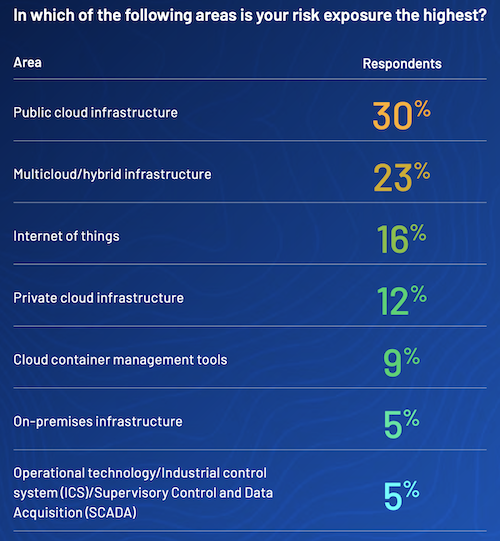
Highest risk exposure.Source: Tenable
This data comes at a critical point in time for publicly traded companies, following new SEC rules on cybersecurity risk management, strategy, governance and incident disclosure that take effect in December of this year.
Disclosure of Incidents
The new rules that mandate the disclosure of material cybersecurity incidents by public companies also stipulate that they outline their processes for assessing, identifying and managing material risks from cybersecurity threats. It also requires them to highlight the oversight processes of boards of directors and executive management in assessing and managing cybersecurity risks. For organizations that do not have these best practices and processes in place, preventive security measures will become a requirement for operations.
“Preventive security is no longer an optional approach to risk management, but a prerequisite,” said Robert Huber, chief security officer and head of research, Tenable. “The scattershot firefighting by security organizations is a recipe for failure, especially with the expansion of the attack surface and exposure points caused by trends like cloud migration and AI. We’re speaking with more and more organizations about the importance of proactively understanding and reducing risk, and this research underscores that many of them know this intuitively, but are struggling with headwinds that are often beyond their control. We hope to foster more collaborative discussion between stakeholders to simplify their practices and get to the risk data they actually need for faster prioritization and remediation.”
Click here to download the report.