
Technology is increasingly valued by companies to help them reduce vulnerability to high-potential near-misses and major hazard events, according to the eighth annual Process Safety Report 2023 from Sphera. Half of those surveyed said their organizations have already invested in visualization tools to manage the health of individual safety barriers/safeguards.
Yet, process safety management (PSM) professionals remain aware of the pivotal role of people in implementing safety policy and technology.
Although respondents see some differences at the individual, company and country levels, they increasingly believe regulatory compliance and safety (governance) reporting requirements helped companies reduce their vulnerability to high-potential incidents. Nearly half of survey participants think companies seem to be moving from compliance-driven process safety management toward proactive management.

Similarly, the majority of respondents believe that process safety management fits into their companies’ environmental, social and governance (ESG) programs. At least 60 percent tie it to governance and environmental aspects, with 40 percent relating it to social aspects. Many respondents also think environmental impact is important from the corporate perspective.
The Sphera Process Safety Survey annually takes a snapshot of the state of process safety and operational risk management. Researchers gather insights and opinions from process safety professionals in some of the most dangerous industries, including petrochemical operations, metals, mining and power utilities.
Five key elements discovered in the survey include:
Companies are still not meeting their process safety goals with one third of safety critical maintenance not achieved.
Roughly 65 percent of respondents see a gap between safety goals and realities. Despite better technology and more resources, survey participants report one- third of scheduled safety-critical maintenance does not occur in a typical month.
Technology enables effective process safety and operational risk management.
A clear 100 percent of respondents agree technology currently enables effective process safety management or will enable it in the future. Eighty percent agree that technology helps reduce vulnerability to hazard events, and over 80 percent believe access to digitized, real-time process safety risk indicators improves risk awareness and safety.
Human factors, including loss of experience and frontline behavior, increase risk and impact safety performance.
In what may seem obvious, but bears repeating, losing experienced personnel increases risk, according to 52 percent of respondents, and 46 percent cite conflicts between policy and frontline worker performance. Similarly, 63 percent report human factors negatively impact safety performance.
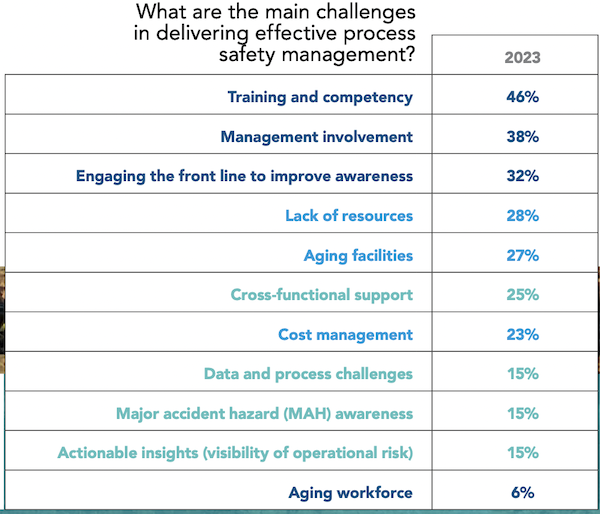
Main challenges to delivering quality process safety management.
Source: Sphera
Respondents said their companies are moving from PSM merely for compliance to proactive PSM.
Forty-one percent believe their organizations go beyond practicing PSM only in order to achieve compliance. Yet only 13 percent take full advantage of the range of tools for compliance and predictive decision- making. This indicates too much reliance on people being able to connect the dots on their own.
Process safety management remains highly significant for ESG programs.
Process safety management fits into ESG programs according to 86 percent of respondents. In addition, 71 percent express concerns about environmental impact from incidents, but 71 percent now worry about the loss of production capabilities.
Just breaking it down a little bit, process safety management is a “disciplined framework for managing the integrity of operating systems and processes that handle hazardous substances.”
To that end, 65 percent of respondents recognize a gap between their company’s process safety goals and the reality, according to the report. Although this number dropped from 69 percent in 2022, it remains alarming that process safety goals are so routinely, even chronically, missed, the researchers said.
Respondents pointed to a number of challenges in delivering effective process safety management.
Human and Organizational Factors
Topping the list are human and organizational factors. Training and competency is named by 46 percent as a challenge to delivering effective process safety management. Next, 38 percent cite management involvement. Also, for 32 percent, engaging the front line to improve awareness is an issue.
To initiate more effective process safety management, leadership is in the best position to drive digital transformation. They should be first to demonstrate how such digital tools will bring tangible value across the enterprise.
Lack of resources was a new response option in the 2023 survey. Here, 28 percent indicate they need more resources. This includes time; money; personnel; or technical, administrative or process-related support systems. Another 23 percent believe cost management is a challenge to effective process safety.
According to 27 percent, aging facilities present challenges for process safety. For example, in the U.S. alone, more than 50 percent of the assets in the hydrocarbon industry are already past their design life, according to a report by Marsh risk advisors.
Aging assets have higher levels of maintenance, and over time, equipment needs replacement. Potentially, years of backlog in maintenance tasks may add up. Also, with various ownerships resulting from mergers and acquisitions, facilities may lack accurate and comprehensive documentation.
According to 25 percent of respondents, structural issues such as a lack of cross-functional support also seem to stand in the way. A digital solution allows functional expertise and information to be more easily shared and provides a repository for knowledge and data from multiple sources.
Click here for more on the Sphera Safety Report 2023.