
Cavitation, or the formation and collapse of destructive gas-filled bubbles resulting from rapid pressure changes in liquids, has been an issue plaguing the industry forever and engineers at the University of Waterloo developed a model on how to predict when it was happening.
“The growth and collapse of cavitation bubbles are fascinating,” said Zhao Pan, a professor of mechanical and mechatronics engineering who led the research. “They are usually small and fast, but they can cause serious damage even on surfaces such as hard alloys and glass.”
Information provided by the model will help engineers design hydraulic systems and develop operation guidelines to minimize wear and tear, avoid major failures, and improve the reliability of the technology.

Cavitation is behind a well-known party trick that involves shattering the bottom of a liquid-filled bottle by striking its open top with the palm of your hand. In that party trick, hitting the bottle causes high acceleration of the liquid relative to the walls of the bottle. That reduces the pressure of the liquid at the bottom, triggering the rapid formation of gaseous bubbles.
When those bubbles collapse, or implode, they temporarily create high temperatures, high-speed micro-jets and shockwaves. Those effects are powerful enough to break the glass.
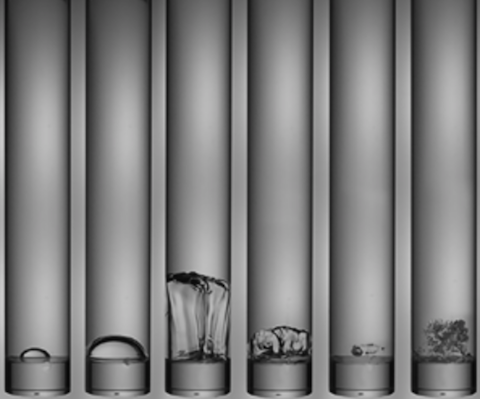
Extreme cavitation scenarios, such as water column separations in hydraulic systems during transient processes caused by large cavitation bubbles, can lead to catastrophic destruction.
The phenomenon is a common culprit in damaged water pipes and ship propellers, for example. In extreme cases, it has led to disastrous pipe failures in hydropower plants.
“On the other hand, the power of these bubbles can also be harnessed for good,” Pan said. “Cavitation can be used to break up kidney stones, kill bacteria without using chemicals, and even in the production of beer and chocolate.”
Pan previously worked with researchers in Japan and the United States on a new theory of small cavitation bubbles caused by the acceleration of liquids that explained how the trick works. Recent work extends those results to the prediction of large bubbles.