
Small amounts of plutonium (Pu) released from the damaged Fukushima Daiichi Nuclear Power Plant (FDNPP) reactors into the environment during the site’s 2011 nuclear disaster. However, the physical, chemical, and isotopic form of the released Pu has remained unknown.
Plutonium was inside cesium-rich microparticles (CsMPs) that were emitted from the site, researchers said. CsMPs are microscopic radioactive particles that formed inside the Fukushima reactors when the melting nuclear fuel interacted with the reactor’s structural concrete. Due to loss of containment in the reactors, the particles released into the atmosphere; many were then deposited across Japan.
Studies have shown the CsMPs are incredibly radioactive and they are primarily composed of glass (with silica from the concrete) and radio-cesium (a volatile fission product formed in the reactors). While the environmental impact and distribution of the CsMPs is still an active subject of debate, learning about the chemical composition of the CsMPs has been shown to offer a much-needed insight into the nature and extent of the FDNPP meltdowns.
The study published in Science of the Total Environment, involving scientists from Japan, Finland, France, Switzerland, the UK, and USA, was led by Dr. Satoshi Utsunomiya and graduate student Eitaro Kurihara (Department of Chemistry, Kyushu University). The team used a combination of advanced analytical techniques (synchrotron-based micro-X-ray analysis, secondary ion mass spectrometry, and high-resolution transmission electron microscopy) to find and characterize the Pu present in the CsMP samples.

The researchers initially discovered incredibly small uranium-dioxide inclusions, of less than 10 nanometers in diameter, inside the CsMPs; this indicated possible inclusion of nuclear fuel inside the particles. Detailed analysis then revealed, for the first-time, that Pu-oxide concentrates were associated with the uranium, and the isotopic composition of the U and Pu matched that calculated for the FDNPP irradiated fuel inventory.
“These results strongly suggest that the nano-scale heterogeneity that is common in normal nuclear fuels is still present in the fuel debris that remains inside the site’s damaged reactors,” Utsunomiya said. “This is important information as it tells us about the extent/severity of the melt-down. Further, this is important information for the eventual decommissioning of the damaged reactors and the long-term management of their wastes.”
In regard to environmental impact, Dr Utsunomiya said, “that as we already know that the CsMPs were distributed over a wide region in Japan (up to 230 km from the FDNPP), small amounts of Pu were likely dispersed in the same way.”
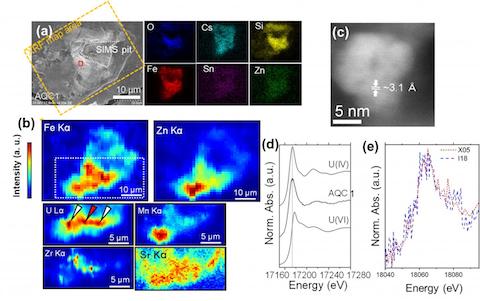
(a)Electron imaging of a CsMP with elemental maps. (b) Synchrotron micro-focus X-ray fluorescence (μXRF) elemental maps. (c) Image of uranium dioxide inclusion in the CsMP. (d) Uranium L3-edge X-ray absorption near-edge structure (XANES) of a discrete point, indicated by the red arrow in (b). The spectrum is plotted alongside U(IV) and U(VI) oxide standards. (e) Discrete-area Pu L3-edge XANES collected from the point indicated by the red arrow.
Source: Kyushu University
The team “will continue to characterize and experiment with the CsMPs, in an effort to better understand their long-term behavior and environmental impact,” said Professor Gareth Law, a co-author on the paper from the University of Helsinki. “It is clear that CsMPs are an important vector of radioactive contamination from nuclear accidents.”
“While the Pu released from the damaged reactors is low compared to that of Cs; the investigation provides crucial information for studying the associated health impact,” said Professor Bernd Grambow, a co-author from Nantes/France.
“The study used an extraordinary array of analytical techniques in order to complete the description of the particles at the atomic-scale,” said Professor Rod Ewing at Stanford University. “This is the type of information required to describe the mobility of plutonium in the environment.”
“It took a long time to publish results on particulate Pu from Fukushima,” Utsunomiya said. “I would like to emphasize that this is a great achievement of international collaboration. It’s been almost ten years since the nuclear disaster at Fukushima, but research on Fukushima’s environmental impact and its decommissioning are a long way from being over.”